Exploring Partial Differential Equations
📋 In this guide
Partial differential equations (PDEs) are mathematical equations that involve functions of several variables and their partial derivatives. These equations are fundamental in describing various physical phenomena such as heat conduction, wave propagation, and quantum mechanics. Despite their importance, students often find partial differential equations intimidating due to their complexity and the abstract nature of the concepts involved. Tackling PDEs requires a solid understanding of calculus, linear algebra, and boundary value problems, which can be daunting for many learners.
In this article, we'll explore what partial differential equations are and why they are challenging for students. You'll learn about the key formulae, step-by-step problem-solving techniques, and real-world applications of PDEs. By the end, you should have a clearer understanding of how to approach these equations and the confidence to tackle them in your studies or professional work.
Understanding partial differential equations is crucial for students pursuing advanced studies in mathematics, physics, and engineering. These equations play a significant role in modeling complex systems and processes. For those preparing for exams like AP Calculus, questions might not directly involve PDEs, but understanding them can enhance your grasp of calculus concepts. In this guide, we aim to demystify partial differential equations and equip you with the tools needed to solve them effectively.
Step-by-Step: How to Solve Partial Differential Equations
Step 1: Understand the Problem
The first step in solving partial differential equations is to thoroughly understand the problem. Identify the unknown function and the variables involved. Recognize the boundary conditions and initial conditions, as these are crucial for finding a unique solution. For example, in the equation u_xx + u_yy = 0, known as Laplace's equation, you need to understand the domain over which you're solving the equation and the conditions applied at the boundaries.
Step 2: Choose the Right Method
The next step involves choosing the appropriate method for solving the PDE. Common methods include separation of variables, Fourier series, and transform methods. Each method has its strengths and is suitable for different types of problems. For instance, separation of variables is often used for linear PDEs with homogeneous boundary conditions. Make sure to match the method to the problem's characteristics to simplify the solution process.
Step 3: Solve the Equation
After selecting the method, apply it to solve the equation. This involves substituting the method's basic assumptions into the PDE and simplifying. For separation of variables, you'll assume the solution can be written as a product of functions, each depending on a single variable. This reduces the PDE to a set of ordinary differential equations (ODEs), which are generally easier to solve.
Step 4: Apply Boundary and Initial Conditions
Finally, use the boundary and initial conditions to find the specific solution to the PDE. This step is crucial because it allows you to determine the constants or functions that arise during the solution process. By applying these conditions, you ensure that the solution satisfies the physical constraints of the problem, leading to a meaningful and applicable result.
🤖 Stuck on a math problem?
Take a screenshot and let our AI solve it step-by-step in seconds
⚡ Try MathSolver Free →Worked Examples
Example 1
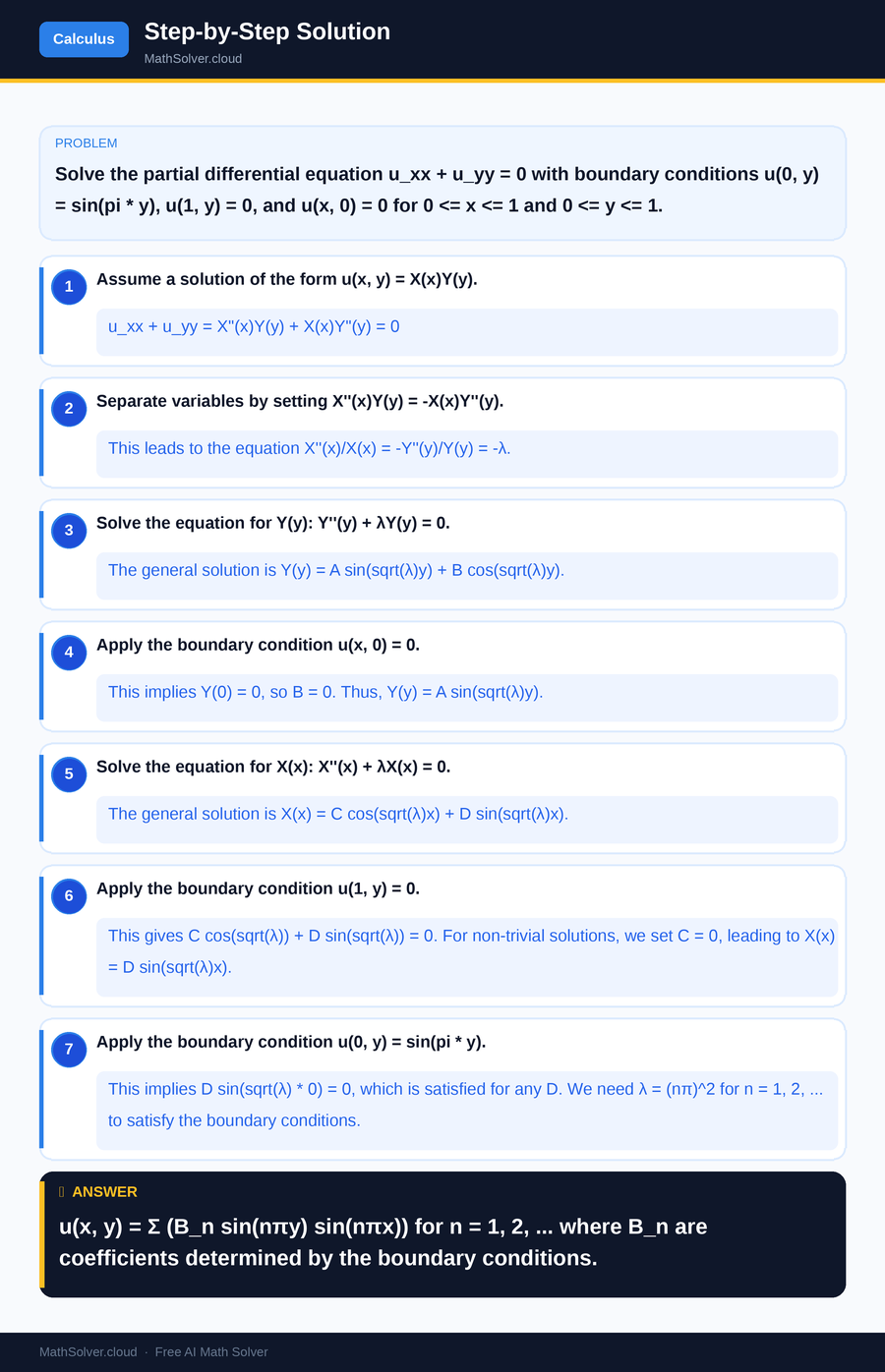
MathSolver Chrome extension solving this problem step-by-step
Example 2
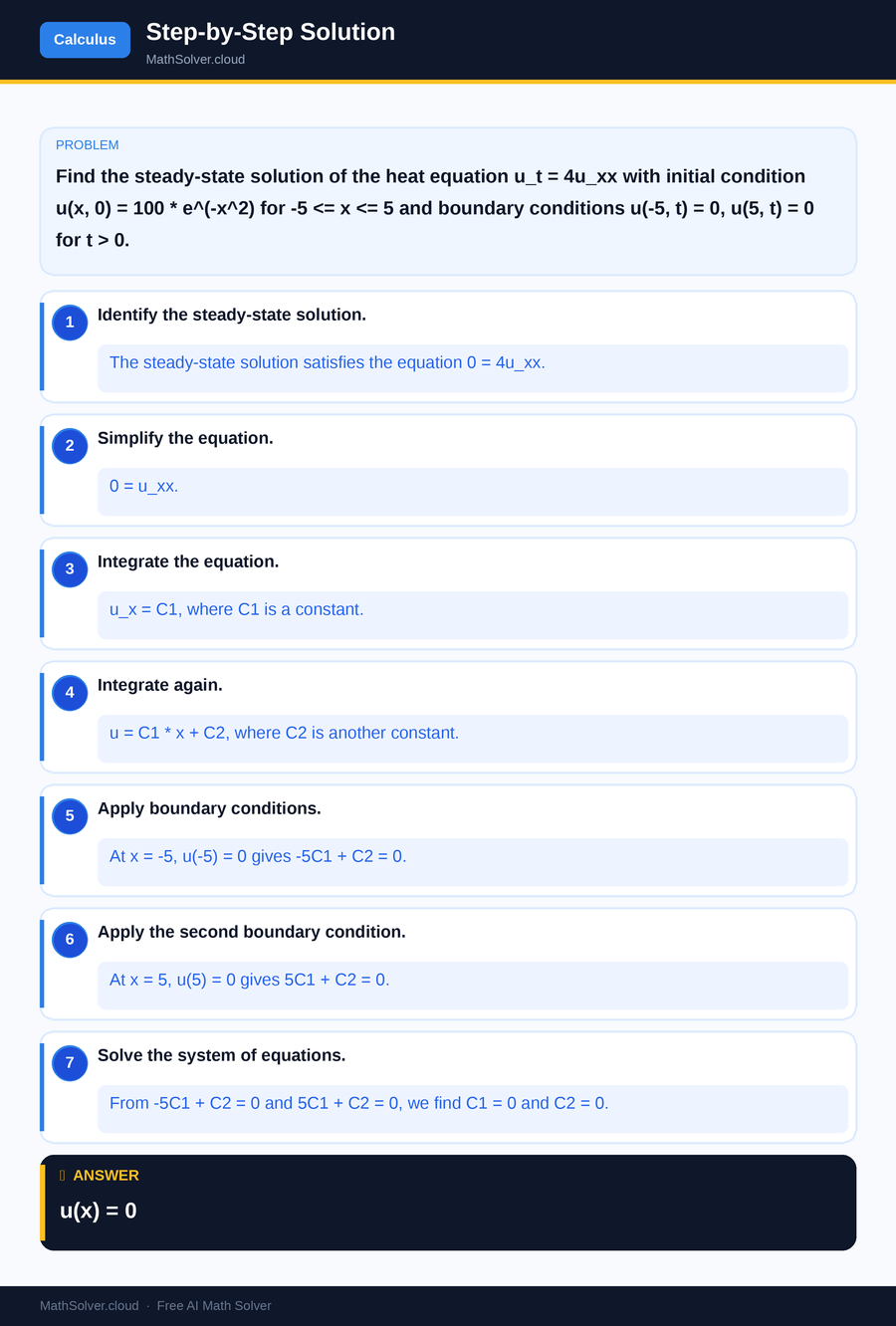
MathSolver Chrome extension solving this problem step-by-step
Common Mistakes to Avoid
One common mistake students make is not thoroughly understanding the boundary and initial conditions of a problem. This can lead to incorrect solutions or solutions that do not satisfy the physical constraints of the problem. Always double-check these conditions to ensure they are applied correctly.
Another mistake is choosing the wrong method for solving a PDE. Each method has specific requirements and limitations. For example, separation of variables is unsuitable for non-linear PDEs. Understanding the problem and selecting the appropriate technique is vital for finding the right solution.
Real-World Applications
Partial differential equations are essential in various real-world applications. In engineering, they model stress and strain in materials, helping design safer structures. PDEs also describe fluid flow, crucial for aerodynamics and hydraulics. Understanding these applications highlights the importance of mastering PDEs for engineering students.
In physics, PDEs are used to model waves, heat conduction, and quantum mechanics. They help predict how physical systems evolve over time, making them indispensable tools in research and technology development. Industries like telecommunications and finance also rely on PDEs for modeling complex systems and making predictions.
Frequently Asked Questions
❓ What are partial differential equations used for?
❓ Does AP Calculus have partial differential equations?
❓ How can AI help with partial differential equations?
❓ Does every engineer need to know partial differential equations?
❓ What are some partial differential equations examples in real life?
🚀 Solve any math problem instantly
2,000+ students use MathSolver every day — join them for free
📥 Add to Chrome — It's Free