Demystifying Ordinary Differential Equations
📋 In this guide
An ordinary differential equation is a mathematical equation that relates a function with its derivatives. It's a fundamental concept in calculus and is crucial for modeling various phenomena in physics, engineering, and other sciences. Students often find ordinary differential equations challenging because they require a strong grasp of calculus concepts and the ability to manipulate complex functions and derivatives. This article aims to demystify ordinary differential equations, offering clear explanations and practical examples to help students understand and solve these equations effectively.
Understanding ordinary differential equations is essential for anyone studying applied sciences, as they are used to describe systems that change over time, such as population growth, electrical circuits, and mechanical systems. Despite their importance, many students struggle with these equations due to their abstract nature and the mathematical rigor involved. However, with the right approach and guidance, mastering ordinary differential equations becomes much more manageable.
In this article, you'll learn about the definition and key formulas of ordinary differential equations, followed by a step-by-step guide to solving them. We will also explore real-world applications, common mistakes to avoid, and provide answers to frequently asked questions. By the end, you'll have a solid understanding of what an ordinary differential equation is and how to tackle it confidently.
Step-by-Step: How to Solve Ordinary Differential Equation
Step 1: Identify the Order and Type of the ODE
The first step in solving an ordinary differential equation is to determine its order, which is the highest derivative present in the equation. For instance, if the equation involves dy/dx and d^2y/dx^2, it is a second-order ODE. It is also crucial to identify the type of ODE, such as linear or nonlinear, homogeneous or non-homogeneous, as this dictates the method of solution.
Step 2: Choose an Appropriate Method
Once you have identified the order and type of the ordinary differential equation, the next step is to select a suitable method for solving it. Common methods include separation of variables, integrating factor, and characteristic equation for linear ODEs. Each method has specific applicability, and choosing the right one is essential for solving the equation efficiently.
Step 3: Solve the Equation
With the method in mind, proceed to solve the ordinary differential equation. This involves applying the chosen method step by step, ensuring that each calculation is accurate. For example, if using separation of variables, you would separate the variables and integrate both sides to find the general solution. Pay attention to constants of integration, as they play a crucial role in finding particular solutions.
Step 4: Apply Initial or Boundary Conditions
Finally, to find a specific solution to the ordinary differential equation, apply any given initial or boundary conditions. These conditions help determine the constants of integration, ensuring that the solution satisfies the problem's specific requirements. This step is crucial for problems that model real-world situations, where initial conditions are often provided.
🤖 Stuck on a math problem?
Take a screenshot and let our AI solve it step-by-step in seconds
⚡ Try MathSolver Free →Worked Examples
Example 1
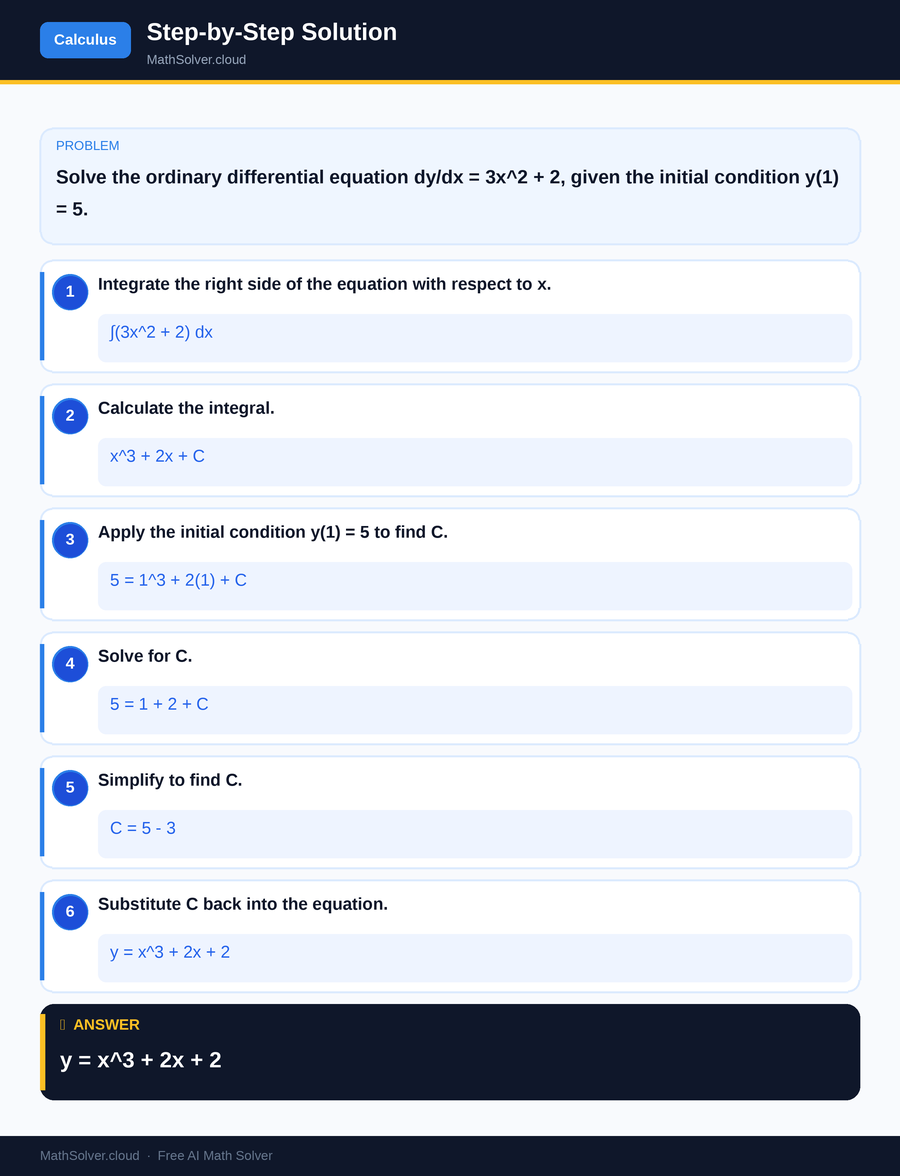
MathSolver Chrome extension solving this problem step-by-step
Example 2
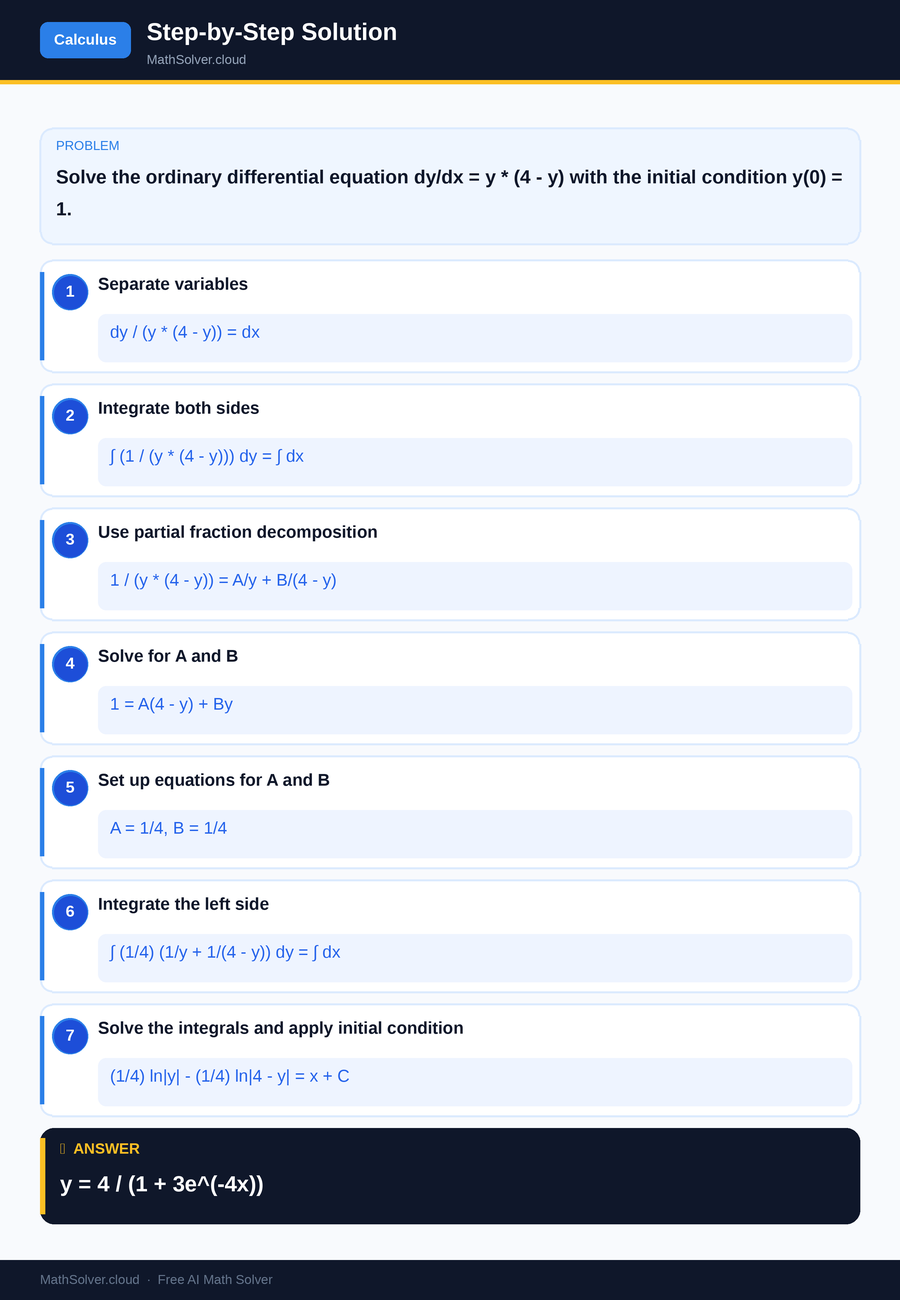
MathSolver Chrome extension solving this problem step-by-step
Common Mistakes to Avoid
One common mistake students make when solving ordinary differential equations is failing to correctly separate variables in separable equations. Ensure that each variable is isolated on one side of the equation before integrating. Another frequent error is neglecting initial or boundary conditions, which are vital for finding specific solutions. Always apply these conditions to determine constants of integration accurately.
Additionally, students often confuse the order of the ordinary differential equation, especially when multiple derivatives are involved. Remember, the order is determined by the highest derivative present. Misidentifying the order can lead to the incorrect application of solution methods, so it’s essential to analyze the equation carefully.
Real-World Applications
Ordinary differential equations are indispensable in modeling real-world phenomena. In physics, they describe the motion of objects under the influence of forces, such as the trajectory of a projectile or the oscillation of a pendulum. Engineers use ordinary differential equations to model electrical circuits, predicting current and voltage over time in response to changes in resistance, capacitance, and inductance.
In biology, ordinary differential equations are used to model population dynamics, such as the growth of a species within an ecosystem. They help predict how populations change over time due to factors like birth rates, death rates, and migration. These equations are vital for understanding and managing natural resources, conservation efforts, and environmental impact assessments.
Frequently Asked Questions
❓ What is an ordinary differential equation?
❓ Why do students struggle with ordinary differential equations?
❓ How can AI help with ordinary differential equations?
❓ What methods are commonly used to solve ordinary differential equations?
❓ How are ordinary differential equations used in economics?
🚀 Solve any math problem instantly
2,000+ students use MathSolver every day — join them for free
📥 Add to Chrome — It's Free