The Role of Math Tutors in Education
📋 In this guide
Math tutors play a crucial role in bridging the gap between students and their understanding of mathematical concepts. The journey through mathematics can be challenging for many students, often due to the abstract nature of the subject, the complexity of mathematical language, and the cumulative nature of its learning process. A math tutor assists students in overcoming these hurdles by offering personalized guidance and support. Whether you're struggling with basic arithmetic, algebra, geometry, or even calculus, a math tutor can tailor their teaching methods to suit your individual learning style, making complex topics more accessible and less intimidating.
Students often find mathematics daunting due to various reasons such as gaps in foundational knowledge, lack of confidence, and the absence of practical application in everyday life. Math tutors can help identify these areas of weakness and work systematically to build a strong foundation. They employ various techniques, including real-life examples and interactive problem-solving, to enhance understanding and retention. This targeted assistance not only improves academic performance but also boosts confidence, encouraging students to tackle more complex problems with ease.
By engaging with math tutors, students gain access to a wealth of knowledge and resources that can significantly enhance their learning experience. Whether you're seeking math tutors near me, exploring platforms like math tutors.org, or considering math tutors online, there are numerous options available to suit your needs. If you're a middle school student, math tutors for middle school can provide the specialized support required to navigate this critical stage of education. In this article, we'll delve deeper into the role of math tutors and how they can transform your mathematical journey.
Step-by-Step: How to Solve Math Tutors
Step 1: Assessing the Student's Needs
The first step in the tutoring process involves assessing the student's needs. This includes identifying the specific areas where the student is struggling, understanding their learning style, and setting clear, achievable goals. A math tutor may conduct an initial assessment test or have a detailed discussion with the student to gather this information. This assessment allows the tutor to tailor the lessons to address the student's weaknesses and build on their strengths, ensuring a personalized and effective learning experience.
Step 2: Developing a Customized Learning Plan
Once the student's needs have been identified, the math tutor can develop a customized learning plan. This plan outlines the topics to be covered, the teaching methods to be employed, and the timeline for achieving the set goals. The learning plan should be flexible, allowing for adjustments as the student progresses. A well-structured plan provides a roadmap for the tutoring sessions, ensuring that both the tutor and the student remain focused and motivated.
Step 3: Interactive and Engaging Lessons
With a learning plan in place, the math tutor can deliver interactive and engaging lessons. This involves using a variety of teaching techniques, such as visual aids, real-life examples, and interactive exercises, to make the learning process enjoyable and effective. Math tutors often incorporate technology, such as online resources and educational software, to enhance the learning experience. By maintaining an interactive environment, the tutor can keep the student engaged and foster a deeper understanding of mathematical concepts.
Step 4: Regular Assessment and Feedback
Regular assessment and feedback are essential components of the tutoring process. Math tutors must continuously evaluate the student's progress through quizzes, tests, and discussions. Providing timely feedback helps the student understand their strengths and areas for improvement. It also enables the tutor to adjust the learning plan as needed, ensuring that the student remains on track to achieve their goals. This ongoing assessment fosters a sense of accountability and encourages continuous improvement.
🤖 Stuck on a math problem?
Take a screenshot and let our AI solve it step-by-step in seconds
⚡ Try MathSolver Free →Worked Examples
Example 1
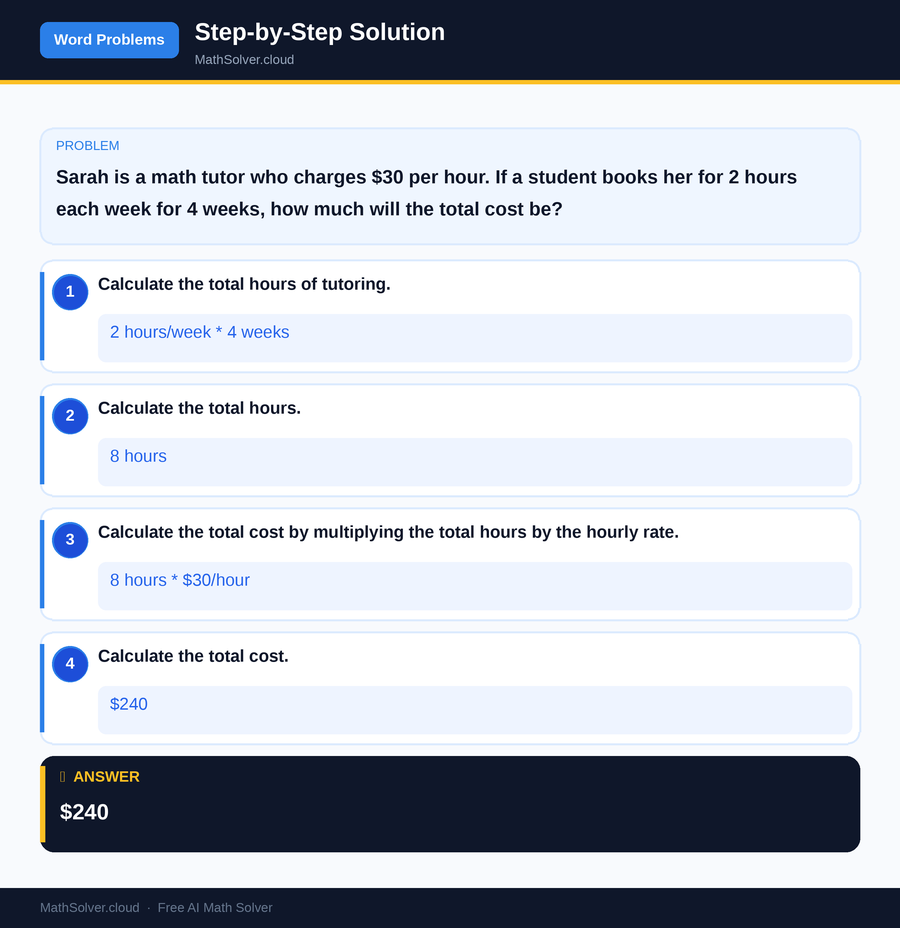
MathSolver Chrome extension solving this problem step-by-step
Example 2
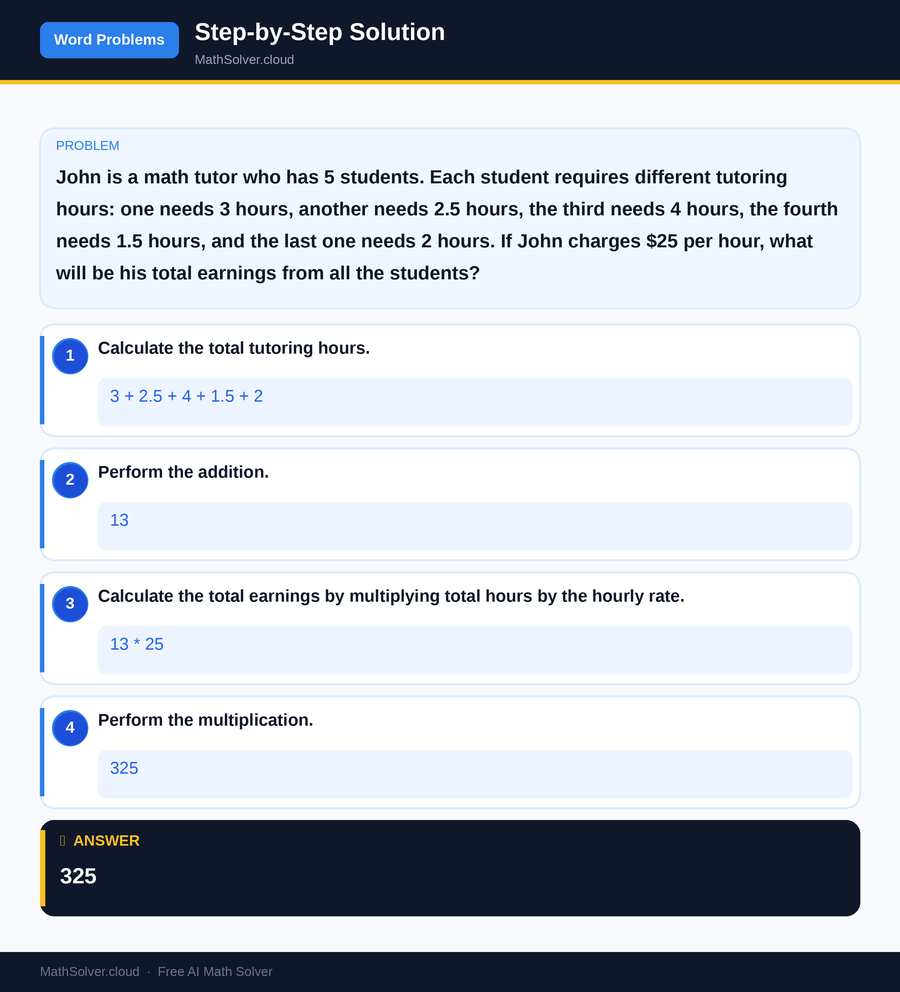
MathSolver Chrome extension solving this problem step-by-step
Common Mistakes to Avoid
One common mistake students make is not practicing enough outside of tutoring sessions. It's essential to practice regularly to reinforce what has been learned and to improve problem-solving skills. Another mistake is relying solely on memorization without understanding the underlying concepts. Math tutors emphasize understanding the 'why' behind mathematical processes, which is crucial for long-term retention and application of knowledge.
Additionally, students often make errors in basic arithmetic or misinterpret problem statements, leading to incorrect solutions. Math tutors can help students develop critical thinking skills and attention to detail, ensuring they read and analyze each problem carefully. By understanding these common pitfalls, students can avoid them and enhance their mathematical competence.
Real-World Applications
Math tutors are not only helpful in academic settings but also play a vital role in preparing students for real-world applications. For instance, mathematical skills are essential in fields such as engineering, finance, and technology, where problem-solving and analytical thinking are crucial. Math tutors can help students understand how mathematical concepts apply to these fields, providing context and relevance to their studies.
Moreover, math tutors can assist students in preparing for standardized tests and college entrance exams, where strong mathematical skills are required. By relating mathematical concepts to real-life scenarios, tutors can make learning more engaging and meaningful, helping students see the value of mathematics beyond the classroom.
Frequently Asked Questions
❓ How can math tutors help improve my grades?
❓ What should I look for when searching for math tutors near me?
❓ How can AI help with math tutors?
❓ Are online math tutors as effective as in-person tutors?
❓ How do math tutors help with hard math problems?
🚀 Solve any math problem instantly
2,000+ students use MathSolver every day — join them for free
📥 Add to Chrome — It's Free