Comprehensive Guide to Math Tutoring
📋 In this guide
Math tutoring is a supportive educational service aimed at helping students improve their mathematical skills and understanding. Many students struggle with math due to its abstract concepts and the cumulative nature of its learning process. Often, a lack of foundational knowledge can lead to difficulties in grasping more advanced topics. In math tutoring, students can expect to receive personalized instruction tailored to their specific needs, helping them to build confidence and competence in math.
Students often face challenges in mathematics because it requires both analytical and critical thinking skills. For example, solving equations, understanding geometric theorems, or interpreting data can be daunting without proper guidance. Math tutoring provides an opportunity for students to engage with these concepts on a deeper level, ensuring they not only understand the material but can also apply it effectively in different contexts. This personalized approach can address individual learning gaps and promote a positive attitude towards math.
Math tutors offer a variety of services, from helping with homework to preparing for exams. They can work with students in person or through online math tutoring platforms, making math tutoring accessible to a wider audience. By working with a tutor, students learn to approach problems methodically and develop their problem-solving abilities. This support can lead to improved academic performance and a greater appreciation for the subject. Whether you're looking for math tutoring near me or prefer the convenience of math tutoring online, there are options to suit every student's needs.
Step-by-Step: How to Solve Math Tutoring
Step 1: Assess the Student's Needs
The first step in effective math tutoring is to assess the student's current level of understanding. This involves identifying the areas where they struggle and the topics they excel in. Tutors can conduct this assessment through diagnostic tests, reviewing past grades, or simply by discussing with the student and parents. Understanding the student's needs allows the tutor to create a customized learning plan that addresses specific challenges and builds on existing knowledge.
Step 2: Develop a Personalized Learning Plan
Once the student's needs are identified, the next step is to develop a personalized learning plan. This plan should outline the goals for the tutoring sessions, the topics to be covered, and the strategies to be used. A well-structured plan helps keep both the tutor and student focused and ensures that progress is being made. This step is crucial for establishing a roadmap that guides the tutoring sessions and measures success.
Step 3: Implement Interactive and Engaging Sessions
With the learning plan in place, the tutor should aim to make each session interactive and engaging. This can be achieved through the use of visual aids, real-world examples, and hands-on activities. Tutors can also incorporate technology by using online resources or the MathSolver Chrome extension, which provides instant step-by-step solutions to complex problems. Interactive sessions keep students motivated and make learning more enjoyable, which can lead to better retention and understanding of the material.
Step 4: Review and Adjust the Learning Plan Regularly
Regular reviews of the learning plan are essential to ensure that the student is making progress. Tutors should evaluate the student's performance through quizzes, practice problems, and feedback during sessions. If necessary, adjustments should be made to the learning plan to address any new challenges or to focus on areas where the student needs additional support. This continuous evaluation process ensures that the tutoring remains effective and aligned with the student's evolving needs.
🤖 Stuck on a math problem?
Take a screenshot and let our AI solve it step-by-step in seconds
⚡ Try MathSolver Free →Worked Examples
Example 1
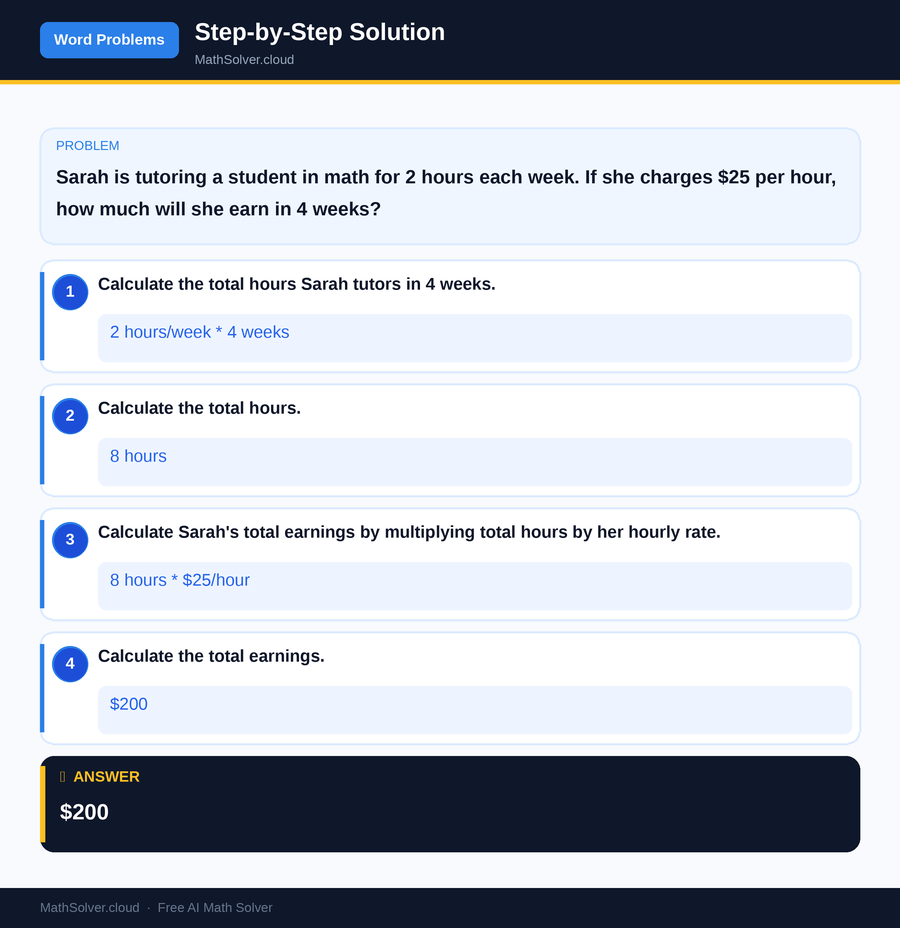
MathSolver Chrome extension solving this problem step-by-step
Example 2
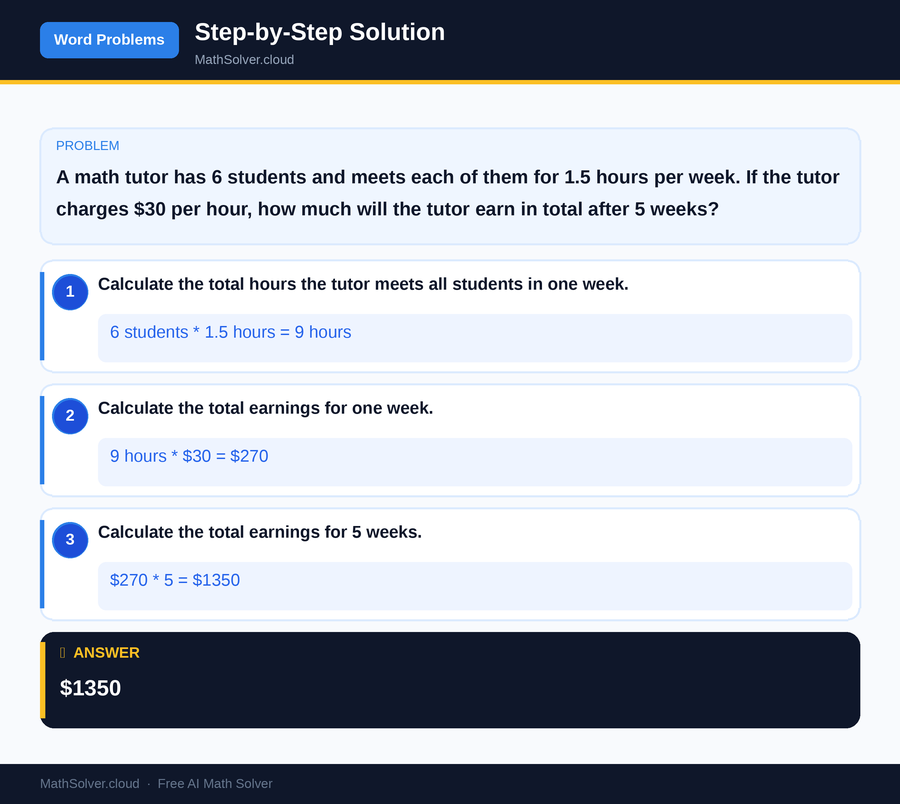
MathSolver Chrome extension solving this problem step-by-step
Common Mistakes to Avoid
One of the most common mistakes students make in math tutoring is relying too heavily on memorization instead of understanding concepts. This approach can lead to difficulties when applying knowledge to different problems. To avoid this, students should focus on understanding the underlying principles and logic behind mathematical operations. Practicing a variety of problems and seeking clarification from the tutor when needed can help reinforce this understanding.
Another mistake is not practicing consistently outside of tutoring sessions. Math requires regular practice to master, and students who only work on problems during their tutoring sessions may struggle to retain information. To overcome this, students should set aside time each day to review concepts and complete practice problems. This consistent effort will help solidify their understanding and improve their ability to solve complex problems.
Real-World Applications
Math tutoring is not only beneficial for academic success but also has practical applications in everyday life. For example, understanding basic arithmetic and algebraic principles is essential for managing personal finances, such as budgeting, calculating interest, and understanding loan terms. These skills are crucial for making informed financial decisions and avoiding common pitfalls.
In professional settings, math tutoring can be invaluable for individuals pursuing careers in fields such as engineering, computer science, and economics. For instance, civil engineers need a strong foundation in mathematics to design and analyze structures. Math tutoring can help students develop the skills required to succeed in these demanding professions. Additionally, understanding complex math problems can lead to better problem-solving abilities and rational reasoning skills, which are highly valued in the workplace.
Frequently Asked Questions
❓ What is math tutoring, and how can it benefit me?
❓ How do I find math tutoring near me?
❓ How can AI help with math tutoring?
❓ Does math tutoring count as service and civil engagement?
❓ What are some practical ways to improve my math skills outside of tutoring?
🚀 Solve any math problem instantly
2,000+ students use MathSolver every day — join them for free
📥 Add to Chrome — It's Free