Exploring Math Problems That Are Hard
📋 In this guide
Math problems that are hard often pose a significant challenge for students, not only testing their computational skills but also their ability to think critically and creatively. These problems typically involve complex concepts that require a deep understanding and the application of various mathematical principles. From advanced algebra to intricate geometry and calculus problems, these math challenges can be daunting. Many students find themselves struggling because they lack the foundational skills or the confidence to tackle these problems effectively. In this article, we will explore the nature of math problems that are hard, offering insights and strategies to help you navigate these challenges with greater ease.
Students often struggle with challenging math problems because they can involve multiple steps and require the integration of different mathematical concepts. This can be overwhelming, especially if the student is not familiar with the specific formulas or methods needed to solve the problem. Moreover, math problems that are hard often require a level of abstract thinking that is not always intuitive. As a result, students might find themselves stuck, unsure of how to proceed. However, with the right guidance and practice, solving complex math problems can become a more manageable and even enjoyable process.
In the following sections, we'll delve into key formulas and definitions that are commonly encountered in hard math problems, providing a step-by-step guide to solving them. We'll also work through some examples to illustrate these concepts in action. By the end of this article, you'll have a better understanding of how to approach math problems that are hard, armed with strategies that can help you excel in your studies. Additionally, we'll touch on tools like MathSolver and Math AI, which can offer critical support in tackling these tough problems.
Step-by-Step: How to Solve Math Problems That Are Hard
Step 1: Understand the Problem
The first crucial step in tackling math problems that are hard is to fully understand what the problem is asking. Read the problem statement carefully and identify the key information and the question you need to answer. Look for any given data and note down what you are trying to find. Sometimes, drawing a diagram or rewriting the problem in your own words can help clarify the situation. Understanding the problem lays the foundation for finding the right solution.
Step 2: Identify the Relevant Formulas or Concepts
Once you have a clear understanding of the problem, the next step is to identify the relevant mathematical formulas or concepts that apply. Determine which areas of math, such as algebra, geometry, or calculus, are involved and recall any pertinent formulas from these domains. For example, if the problem involves a quadratic equation, remember the quadratic formula. This step often involves refreshing your memory on key concepts that will guide your problem-solving approach.
Step 3: Develop a Strategy
After identifying the necessary formulas, develop a strategic plan for solving the problem. Decide the order in which you will apply the formulas and how you will organize your calculations. Break down the problem into smaller, more manageable parts if possible, and tackle each part systematically. This strategy will serve as your roadmap, guiding you through the complexities of the problem and ensuring that you stay on track.
Step 4: Execute and Verify Your Solution
Finally, execute your plan by performing the calculations step-by-step, carefully applying the identified formulas. Double-check each step to avoid errors, and ensure your calculations are correct. Once you arrive at a solution, verify it by plugging it back into the original problem to see if it makes sense. If the solution holds, you can be confident in your answer. If not, revisit your strategy and calculations to identify any mistakes.
🤖 Stuck on a math problem?
Take a screenshot and let our AI solve it step-by-step in seconds
⚡ Try MathSolver Free →Worked Examples
Example 1

MathSolver Chrome extension solving this problem step-by-step
Example 2
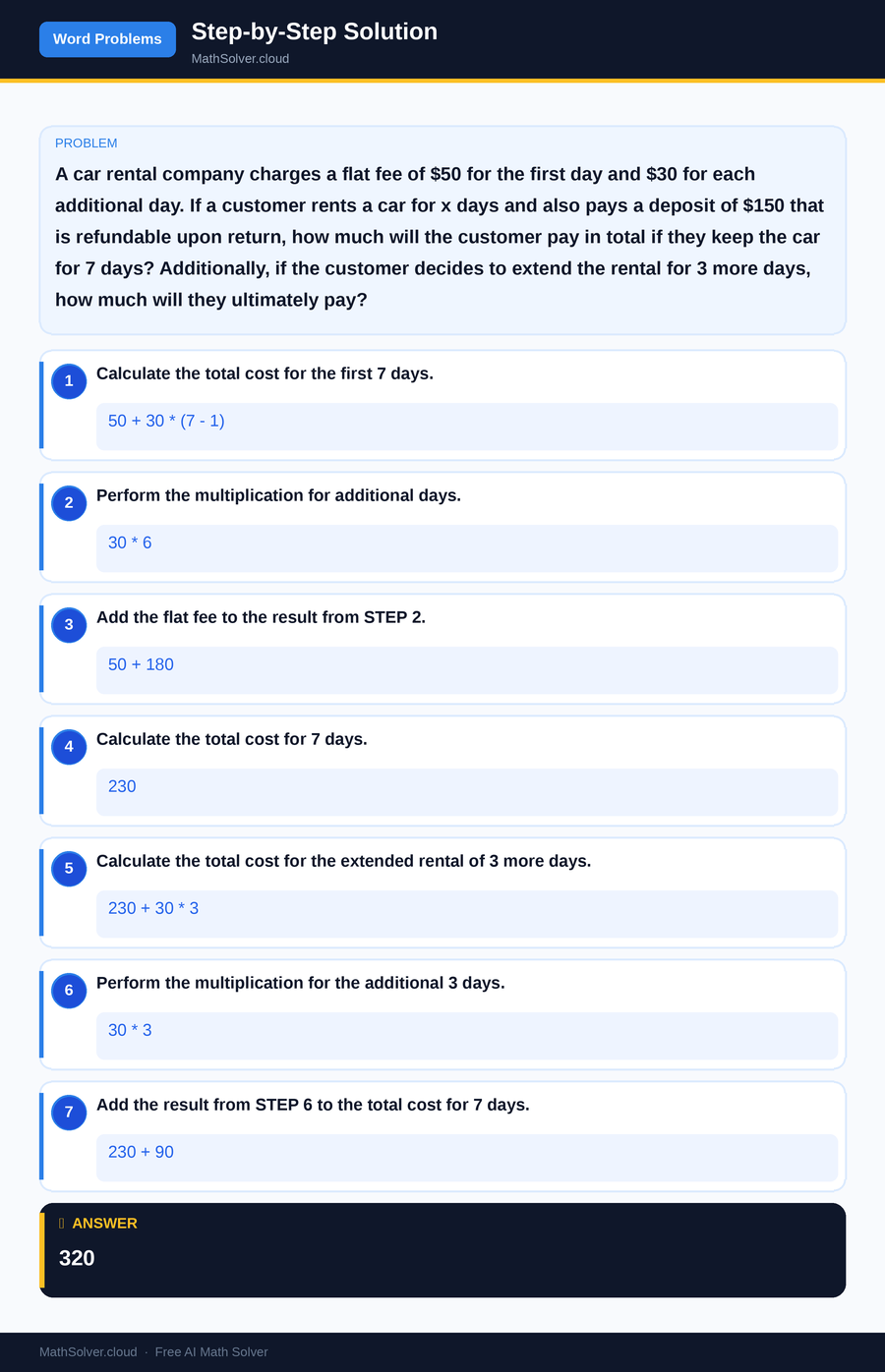
MathSolver Chrome extension solving this problem step-by-step
Common Mistakes to Avoid
A common mistake students make when solving math problems that are hard is misreading the problem, leading to incorrect assumptions about what is being asked. It's crucial to take time to understand the problem fully before jumping into calculations. Another frequent error is neglecting to check your work. Even small arithmetic mistakes can lead to incorrect answers, so verifying each step is vital.
Another pitfall is becoming too reliant on memorized formulas without understanding their derivation or application. This can lead to confusion, especially when faced with problems that require a more nuanced approach or integration of multiple concepts. To avoid this, focus on understanding the underlying principles and logic behind the formulas, ensuring you can adapt them to various situations.
Real-World Applications
Math problems that are hard often have real-world applications that extend far beyond the classroom. For instance, engineers frequently encounter complex math problems when designing structures or systems, requiring precise calculations and an understanding of advanced mathematical concepts. Similarly, in finance, professionals use challenging mathematical models to predict market trends and make informed investment decisions.
In everyday life, math problems that are hard can appear in various forms, such as planning a budget, optimizing travel routes, or even in cooking when scaling recipes. These applications highlight the importance of being able to tackle difficult math problems, as they equip individuals with the skills needed to solve practical problems efficiently and effectively.
Frequently Asked Questions
❓ What are math problems that are hard?
❓ Why do students struggle with math problems that are hard?
❓ How can AI help with math problems that are hard?
❓ What is a simple strategy for approaching hard math problems?
❓ Can you recommend resources for additional help with hard math problems?
🚀 Solve any math problem instantly
2,000+ students use MathSolver every day — join them for free
📥 Add to Chrome — It's Free