Demystifying Math Problems: A Comprehensive Guide
📋 In this guide
Math problems are a fundamental part of mathematics education, presenting students with challenges that require critical thinking and problem-solving skills. From simple arithmetic to complex calculus, math problems come in various forms and difficulty levels. The primary goal of solving math problems is to develop a deeper understanding of mathematical concepts and improve logical reasoning. However, many students find themselves struggling with math problems due to a lack of foundational skills, anxiety, or simply because they encounter math problems that are hard. This article aims to demystify math problems, providing you with techniques and strategies to solve them effectively.
Students often struggle with math problems because they require more than just memorization of formulas. Solving these problems involves understanding the underlying principles and applying them in a logical sequence. This process can be daunting, especially when faced with hard math problems or those that appear on standardized tests like the SAT. However, with practice and the right approach, anyone can improve their problem-solving skills. In this guide, we will break down the process of solving math problems into manageable steps and provide examples to illustrate each concept.
By the end of this article, you'll be equipped with the knowledge to tackle a variety of math problems confidently. You'll learn not only how to approach and solve math problems but also how to recognize common pitfalls and apply your skills in real-world scenarios. Whether you're a fifth grader grappling with basic arithmetic or a high school student preparing for the SAT, this guide will provide valuable insights to enhance your mathematical abilities.
Step-by-Step: How to Solve Math Problems
Step 1: Understand the Problem
The first step in solving any math problem is to fully understand what the problem is asking. Carefully read the problem statement and identify the key information given. Highlight or underline important data points and determine what the problem requires you to find. For instance, in a problem involving the sharing of apples, identify the total number of apples and the number of people sharing them. This initial step sets the foundation for the rest of the problem-solving process.
Step 2: Devise a Plan
Once you understand the problem, the next step is to devise a plan for how to solve it. This might involve recalling relevant formulas or strategies that apply to the problem type. If you're solving a division problem, consider how you can break down the total quantity into equal parts. For geometry problems, visualize the scenario or draw a diagram to help with spatial reasoning. The plan you create will guide your approach to arriving at a solution.
Step 3: Carry Out the Plan
With a plan in place, execute it step-by-step, ensuring that you follow the logical sequence you've established. Perform calculations carefully, keeping track of your work to avoid errors. If the problem involves multiple steps, tackle them one at a time, and check your results after each step. For example, when dividing apples among friends, perform the division to find out how many apples each friend receives, ensuring that no apples are left unaccounted for.
Step 4: Review and Reflect
After arriving at a solution, take the time to review your work and ensure that it makes sense. Check your calculations and verify that your solution addresses the problem's requirements. Reflect on the process you followed and consider whether there were more efficient or simpler methods you could have used. This reflection not only helps confirm your solution but also strengthens your problem-solving skills for future math problems.
🤖 Stuck on a math problem?
Take a screenshot and let our AI solve it step-by-step in seconds
⚡ Try MathSolver Free →Worked Examples
Example 1
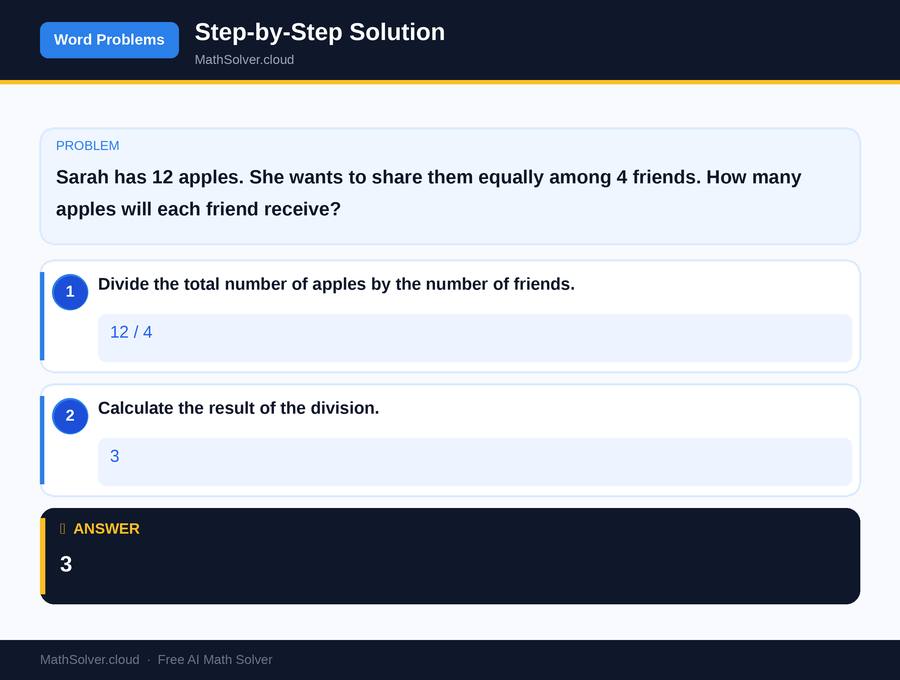
MathSolver Chrome extension solving this problem step-by-step
Example 2
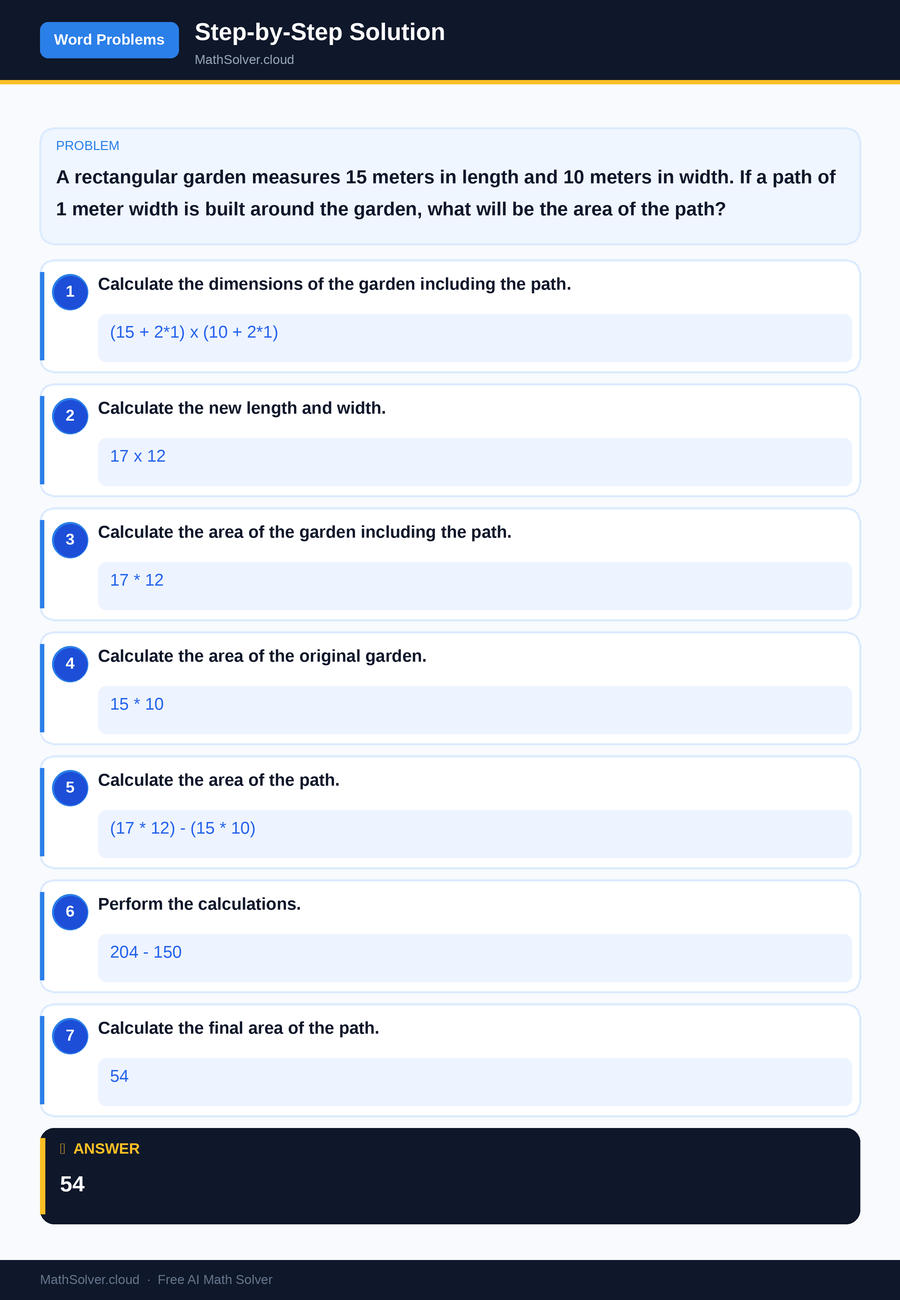
MathSolver Chrome extension solving this problem step-by-step
Common Mistakes to Avoid
One common mistake students make when solving math problems is misreading the problem statement and missing crucial information. This oversight can lead to incorrect solutions. To avoid this, carefully read the problem multiple times and highlight key details.
Another frequent error is incorrect calculations due to rushing or lack of attention to detail. Double-checking each step and using estimation to verify the reasonableness of your answer can help prevent these mistakes.
Students also sometimes apply the wrong formula or method to a problem. This often occurs when they don't fully understand the problem type or the principles involved. To avoid this, ensure you have a strong grasp of the foundational concepts and practice identifying which formulas and methods apply to different types of problems.
Real-World Applications
Math problems are not just academic exercises; they have real-world applications that are critical in various fields. For instance, in engineering, solving complex math problems is essential for designing structures and systems. Understanding geometry and algebra is crucial for architects who use these skills to create accurate building plans.
In everyday life, math problems help us make informed decisions. Whether it's budgeting household expenses, calculating travel times, or understanding statistics in the news, the ability to solve math problems equips individuals with rational reasoning skills that are applicable in numerous situations. Our complete Word Problems & Homework guide can provide further insights into using math in real-life scenarios.
Frequently Asked Questions
❓ What are math problems?
❓ Why do students struggle with math problems?
❓ How can AI help with math problems?
❓ How should I approach SAT math problems?
❓ What are some practical tips for solving hard math problems?
🚀 Solve any math problem instantly
2,000+ students use MathSolver every day — join them for free
📥 Add to Chrome — It's Free