Mastering the Math Problem Solver
📋 In this guide
A math problem solver is an invaluable tool for students seeking to master mathematical concepts and improve their problem-solving skills. Students often struggle with math due to its abstract nature and the need for logical reasoning. This difficulty is compounded by the pressure of homework, where students frequently encounter challenging problems. In this article, we will explore how a math problem solver can demystify complex problems and provide clear, step-by-step solutions.
Understanding mathematics is crucial for academic success and real-world applications. However, many students find themselves overwhelmed by the intricacies of formulas and theorems. This is where a math problem solver comes into play. It simplifies the process, allowing students to focus on understanding rather than just finding the answer. By breaking down problems into manageable steps, a math problem solver with steps helps students learn the underlying principles.
Throughout this article, we will delve into the mechanics of a math problem solver, illustrate its use through examples, and provide tips for avoiding common mistakes. Whether you're tackling algebra or geometry, these tools are designed to support and enhance your learning experience. By the end, you'll have a comprehensive understanding of how to leverage math problem solvers for your studies.
Step-by-Step: How to Solve Math Problem Solver
Step 1: Identify the Problem
The first step in using a math problem solver is to clearly identify the problem you're trying to solve. Start by carefully reading the problem statement, ensuring you understand what is being asked. Highlight key terms and numbers, and determine what type of mathematical operation or formula is required. For instance, if you're dealing with an algebra problem, identify the variables and constants involved. This step is crucial as it sets the foundation for solving the problem accurately.
Step 2: Choose the Right Solver
Once you have identified the problem, choose the appropriate math problem solver. There are various types available, including free math problem solvers and AI math problem solvers with steps shown. If you're dealing with algebra, consider an algebra math problem solver that specializes in equations and inequalities. Selecting the right tool ensures that you receive accurate and relevant solutions tailored to your specific problem type.
Step 3: Input the Problem
After selecting the appropriate solver, the next step is to input the problem. Enter the mathematical expression or equation into the solver's interface. Many online solvers allow you to type directly or use a virtual keyboard for special symbols. Ensure that you input the problem accurately, as any errors can lead to incorrect solutions. Double-check your input for mistakes before proceeding to the next step.
Step 4: Analyze the Solution
Once the problem is entered, the math problem solver will generate a solution. It's important to analyze this solution carefully. Look at each step provided by the solver, and try to understand the logic and operations used. This analysis helps reinforce your understanding of the mathematics involved. If the solver provides a step-by-step guide, follow along to see how each operation leads to the final answer. This practice not only helps you solve the current problem but also equips you with skills for future problem-solving.
🤖 Stuck on a math problem?
Take a screenshot and let our AI solve it step-by-step in seconds
⚡ Try MathSolver Free →Worked Examples
Example 1
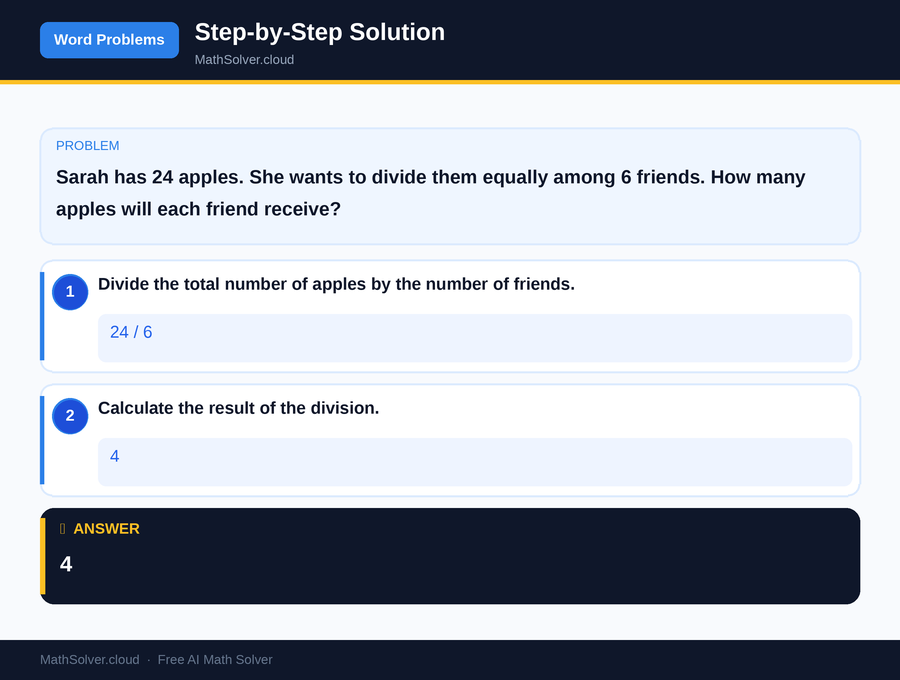
MathSolver Chrome extension solving this problem step-by-step
Example 2

MathSolver Chrome extension solving this problem step-by-step
Common Mistakes to Avoid
One common mistake students make when using a math problem solver is inputting the problem incorrectly. Misplacing a decimal or a negative sign can lead to incorrect solutions. To avoid this, always double-check your input before proceeding. Another mistake is relying solely on the solver without understanding the steps. While a math problem solver with steps shown is helpful, it's crucial to engage with the solution process to reinforce learning.
Additionally, some students overlook the importance of choosing the right type of solver. Not all solvers are equipped to handle every type of problem. Ensure you use a solver that matches the mathematical concept you're working on. By being mindful of these mistakes, you can maximize the benefits of using math problem solvers.
Real-World Applications
Math problem solvers have numerous real-world applications beyond academic settings. For example, in finance, they can be used to calculate interest rates, loan payments, and investment returns. By simplifying complex calculations, math problem solvers aid financial analysts in making informed decisions.
In engineering, math problem solvers are used to design and assess structural components. Calculating forces, load-bearing capacities, and material requirements often involve complex equations that can be streamlined with the help of these tools. From construction projects to product design, math problem solvers play a critical role in ensuring precision and safety.
Frequently Asked Questions
❓ What is a math problem solver?
❓ Why do students struggle with math problems?
❓ How can AI help with math problem solver?
❓ Can math problem solvers be used for all types of problems?
❓ How can I improve my problem-solving skills using a math problem solver?
🚀 Solve any math problem instantly
2,000+ students use MathSolver every day — join them for free
📥 Add to Chrome — It's Free