Mastering Calculus with an Integral Solver with Steps
📋 In this guide
An integral solver with steps is a valuable tool for students tackling calculus problems. It provides a detailed breakdown of how to solve integrals, which are fundamental to understanding calculus. Many students find integrals challenging because they require a deep grasp of different mathematical techniques and concepts. An integral solver with steps can demystify these techniques by showing how to approach each problem methodically.
Students often face difficulties in understanding the underlying principles of integrals, such as why certain functions require specific techniques. The integral solver with steps not only solves the problem but also explains each stage of the calculation. This process enhances the learning experience, making it easier for students to grasp complex concepts. With guidance from an integral solver, students can improve their problem-solving skills and build confidence in their mathematical abilities.
By using an integral solver with steps, learners can expect to master both definite and indefinite integrals. This tool is especially useful for those who need to solve integrals as part of their coursework in subjects like physics, engineering, and higher-level mathematics. Moreover, integral solvers are accessible online, often for free, which makes them an invaluable resource for students everywhere.
Step-by-Step: How to Solve Integral Solver With Steps
Step 1: Identify the Type of Integral
The first step in using an integral solver with steps is to determine whether the integral is definite or indefinite. A definite integral includes limits of integration, such as from x = a to x = b, which means the solution will be a specific numerical value. An indefinite integral lacks these limits and results in a family of functions plus a constant of integration, C. Recognizing the type of integral guides the approach to solving it.
Step 2: Choose the Appropriate Integration Technique
Different integrals require different techniques, such as substitution, integration by parts, or partial fraction decomposition. For a function like f(x) = x^2, basic power rule integration suffices, while more complex functions may require substitution or other strategies. Understanding the characteristics of the function to be integrated is crucial in selecting the correct method, which the integral solver with steps will guide you through.
Step 3: Perform the Integration
Once the method is chosen, apply it to solve the integral. For instance, if using substitution, replace the variable with a function that simplifies the integral, perform the integration, and then substitute back. For definite integrals, compute the antiderivative and evaluate it at the upper and lower limits. The integral solver with steps will show each calculation, ensuring clarity in the process.
Step 4: Verify and Interpret the Solution
After solving the integral, it's important to verify the result. For indefinite integrals, ensure the antiderivative is correct by differentiating it to see if the original function is obtained. For definite integrals, check the calculations to confirm the numerical value. Understanding the solution's interpretation, such as the area under a curve for definite integrals, is also crucial. The integral solver will help interpret these results in context.
🤖 Stuck on a math problem?
Take a screenshot and let our AI solve it step-by-step in seconds
⚡ Try MathSolver Free →Worked Examples
Example 1
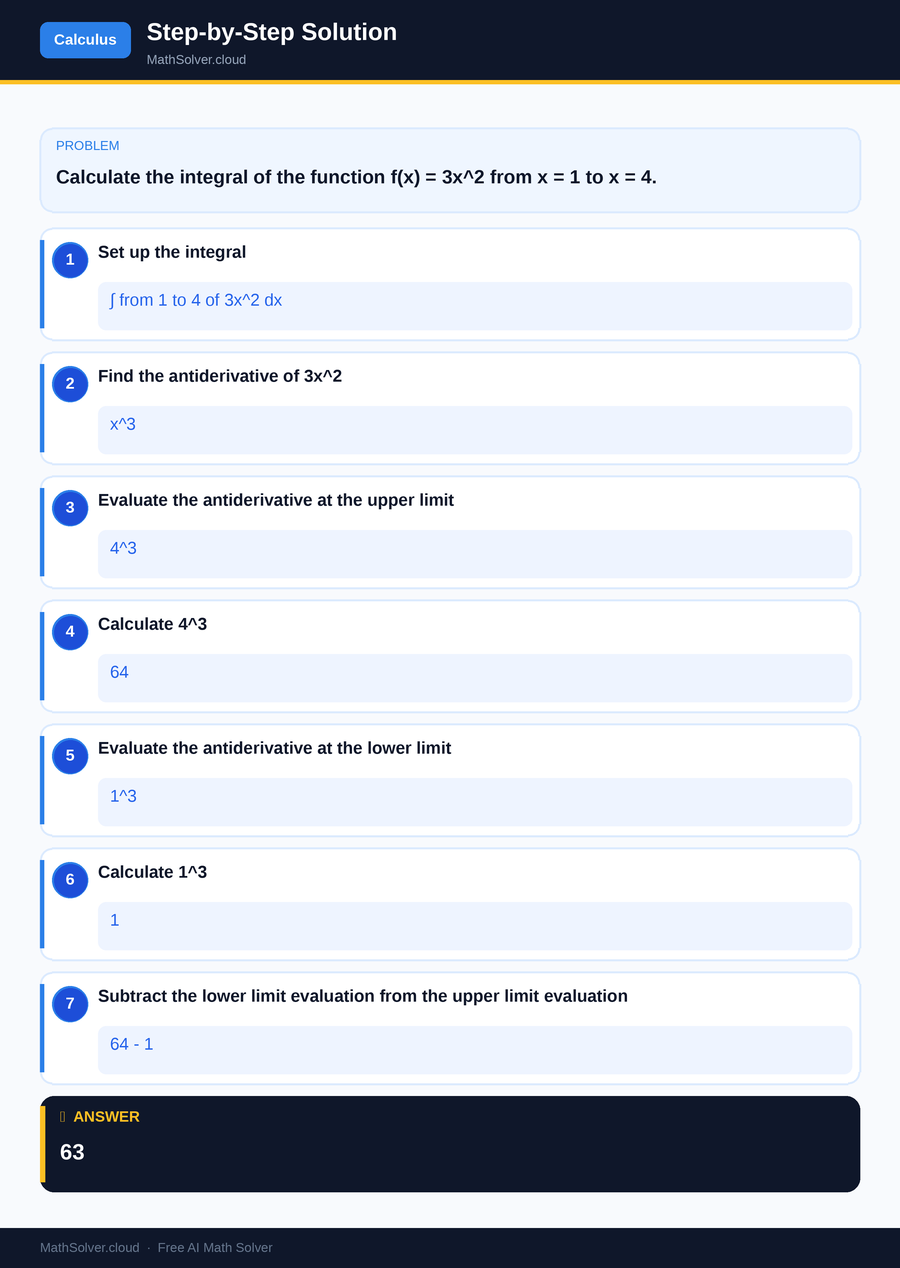
MathSolver Chrome extension solving this problem step-by-step
Example 2
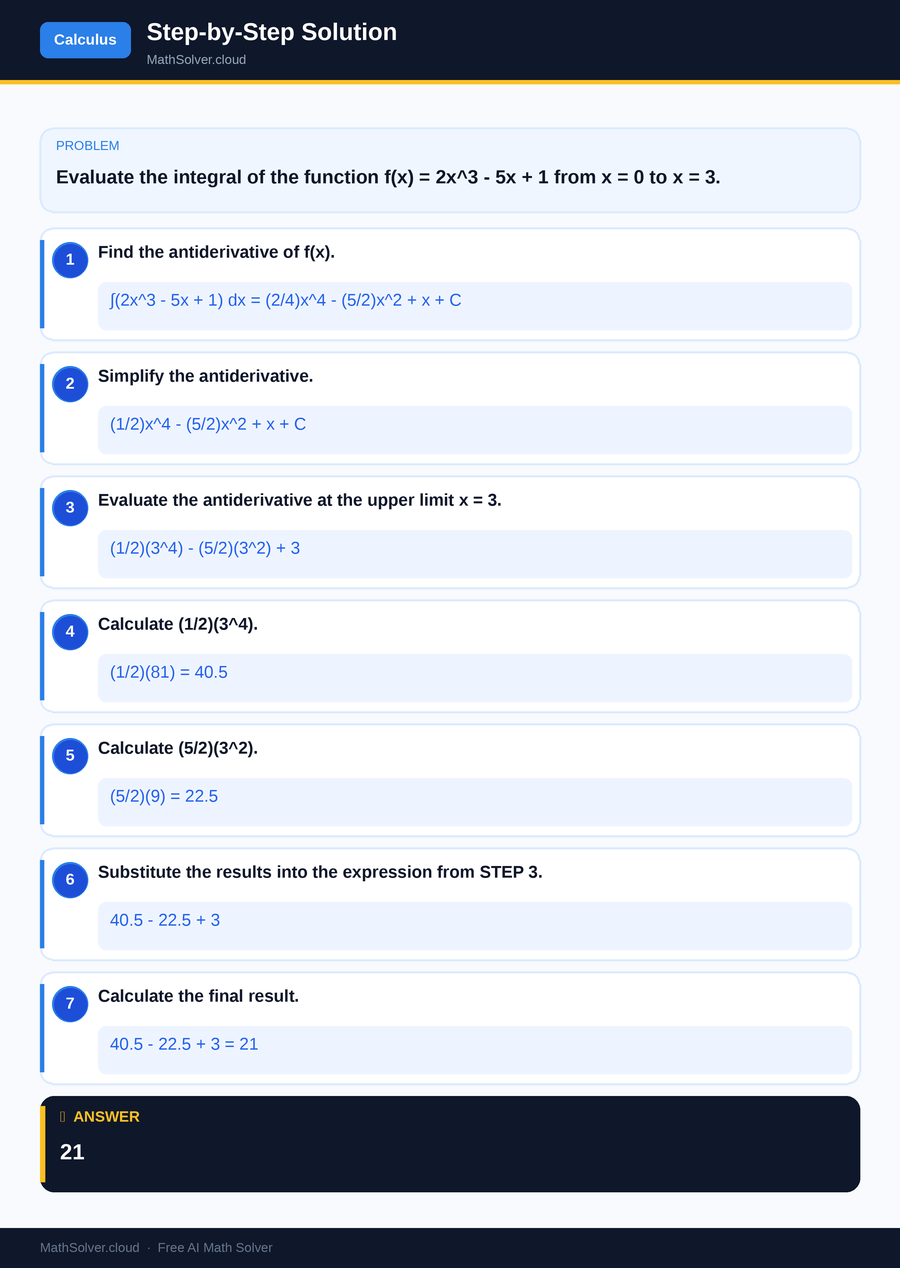
MathSolver Chrome extension solving this problem step-by-step
Common Mistakes to Avoid
One common mistake when solving integrals is misidentifying the type of integral, which can lead to incorrect solutions. Students often forget to apply the constant of integration when dealing with indefinite integrals, resulting in incomplete answers. To avoid this, always double-check the problem to determine if limits are present and remember to add the constant C for indefinite integrals.
Another frequent error is using the wrong integration technique. For instance, attempting to apply the power rule to a function that requires substitution or integration by parts can lead to incorrect results. It's crucial to understand the function's structure and choose the appropriate method. Utilizing an integral solver with steps can help identify the correct technique by breaking down the process clearly.
Real-World Applications
Integrals are used extensively in various fields, making the ability to solve them essential. In physics, integrals calculate quantities like work, energy, and center of mass. For example, determining the work done by a force over a distance involves integrating the force function with respect to distance.
In engineering, integrals are used to design and analyze systems, such as determining the flow of fluids through pipes or the stress on materials. Understanding these applications highlights the importance of mastering integrals, which can significantly impact technological advancements. An integral solver with steps aids in grasping these applications by providing clarity and precision in calculations.
Frequently Asked Questions
❓ What is an integral solver with steps?
❓ Why do students find integrals challenging?
❓ How can AI help with integral solver with steps?
❓ What is the difference between definite and indefinite integrals?
❓ Are there free resources for solving integrals?
🚀 Solve any math problem instantly
2,000+ students use MathSolver every day — join them for free
📥 Add to Chrome — It's Free