Understanding the Fundamental Theorem of Calculus
📋 In this guide
The fundamental theorem of calculus is a cornerstone of mathematical analysis and an essential concept in understanding the relationship between differentiation and integration. It bridges the gap between these two main branches of calculus, providing a way to evaluate definite integrals and establish the antiderivative. Many students find the fundamental theorem of calculus challenging due to its abstract nature and the precision required to apply it correctly. However, mastering this theorem is crucial for success in advanced calculus and related fields.
By grasping the fundamental theorem of calculus, students will unlock the ability to solve complex problems involving the area under curves, rates of change, and accumulated quantities. This theorem not only simplifies the process of finding definite integrals but also deepens the understanding of how calculus describes the physical world. In this guide, we will explore the fundamental theorem of calculus in detail, offering a clear explanation, step-by-step guidance, and practical examples to solidify your comprehension.
Through this article, you will learn about the two parts of the fundamental theorem of calculus: the fundamental theorem of calculus part 1, which relates the antiderivative to the area under a curve, and the fundamental theorem of calculus part 2, which provides a method for evaluating definite integrals. By the end, you'll have a strong grasp of how to apply these concepts and avoid common pitfalls, setting a solid foundation for further studies in mathematics.
Step-by-Step: How to Solve Fundamental Theorem Of Calculus
Step 1: Understanding the Relationship Between Derivatives and Integrals
The first step in mastering the fundamental theorem of calculus is to understand the relationship between derivatives and integrals. The fundamental theorem essentially states that integration and differentiation are inverse processes. When you differentiate a function, you find the rate of change, while integration accumulates the total quantity. This relationship is crucial because it allows the computation of an integral using antiderivatives, simplifying the process significantly.
Step 2: Applying the First Part of the Fundamental Theorem
The fundamental theorem of calculus part 1, also known as the first fundamental theorem of calculus, provides the foundation for evaluating definite integrals. When applying this part, identify a continuous function f on a closed interval [a, b] and find an antiderivative F. The integral from a to b of f(x) dx can then be calculated as F(b) - F(a). This step requires recognizing an appropriate antiderivative and ensuring that the function is continuous over the interval.
Step 3: Utilizing the Second Part of the Fundamental Theorem
The second fundamental theorem of calculus, or fundamental theorem of calculus part 2, involves finding the derivative of an integral function. If you have a continuous function f defined on [a, b], and F is an antiderivative of f, then the derivative of F is f itself. This part of the theorem is particularly useful for confirming that a function is indeed an antiderivative and for solving differential equations, which can be greatly aided by tools like a differential equation calculator.
Step 4: Practicing with Examples and Avoiding Errors
The fourth step is to practice applying both parts of the fundamental theorem of calculus through examples to solidify your understanding. Work through problems systematically, verifying that the function is continuous and correctly identifying antiderivatives. Be mindful of common errors such as misidentifying the limits of integration or neglecting to subtract F(a) from F(b). With practice, using the fundamental theorem will become more intuitive.
🤖 Stuck on a math problem?
Take a screenshot and let our AI solve it step-by-step in seconds
⚡ Try MathSolver Free →Worked Examples
Example 1

MathSolver Chrome extension solving this problem step-by-step
Example 2
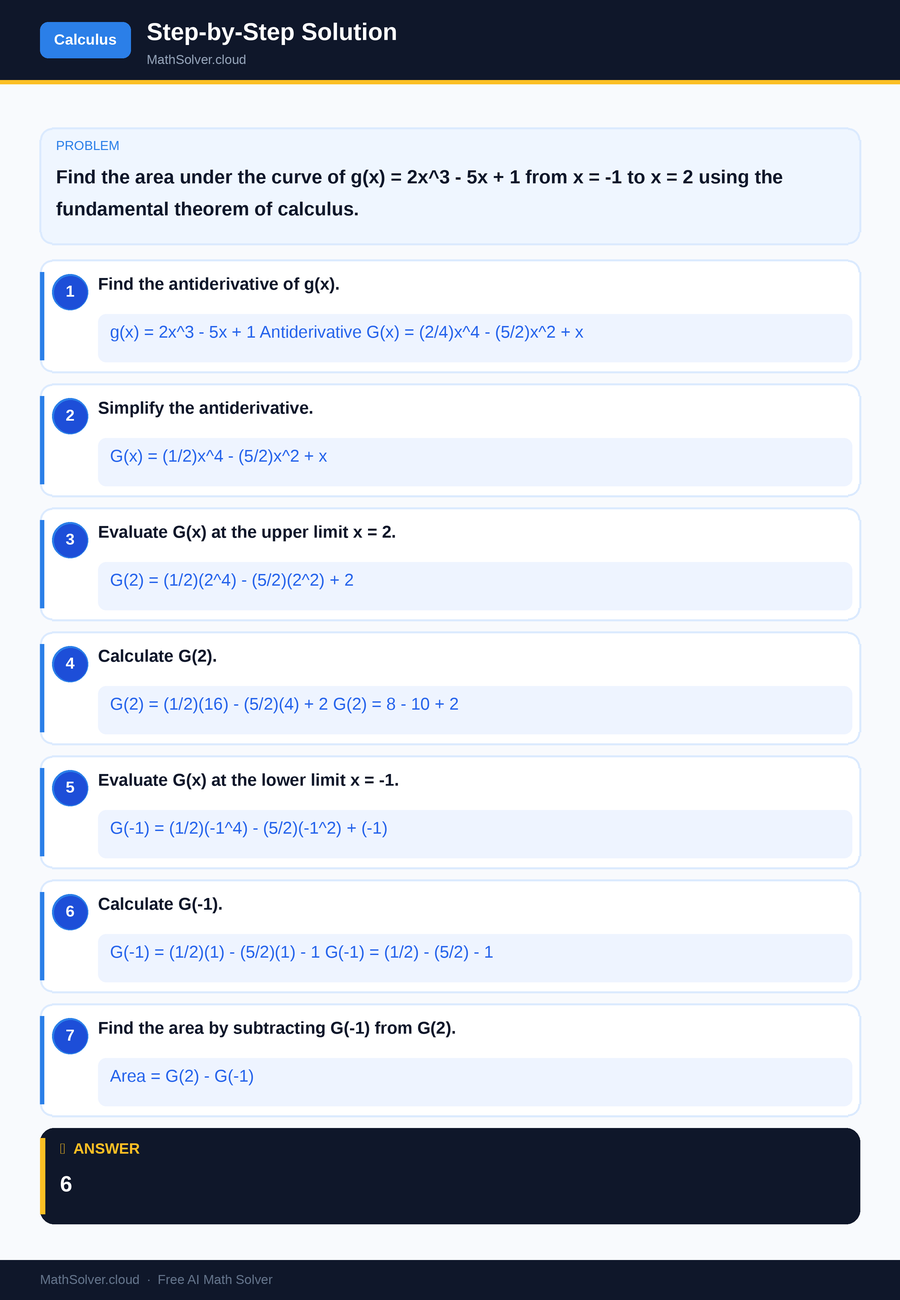
MathSolver Chrome extension solving this problem step-by-step
Common Mistakes to Avoid
One common mistake students make when applying the fundamental theorem of calculus is failing to correctly identify the limits of integration. This error can lead to incorrect results, as the limits determine the specific part of the curve being evaluated. Always double-check that the limits are accurately placed in the antiderivative formula as F(b) - F(a).
Another frequent error is miscalculating the antiderivative of the function. Ensure that the antiderivative is correctly derived from the original function, as any mistake in this step will propagate through the rest of the calculation. Consistent practice and verification against known results can help avoid these pitfalls.
Real-World Applications
The fundamental theorem of calculus has numerous real-world applications, particularly in fields that involve continuous change or accumulation. For example, in physics, it is used to calculate quantities like displacement and work done when given velocity or force functions. Engineers use it to determine the stress and strain on materials by integrating stress functions over a given area or volume.
In economics, the fundamental theorem of calculus helps model and predict economic behaviors by integrating marginal cost or revenue functions to find total cost or revenue. These applications demonstrate the theorem’s power in solving practical problems, making it an indispensable tool for professionals in various disciplines.
Frequently Asked Questions
❓ What is the fundamental theorem of calculus?
❓ Why do students struggle with the fundamental theorem of calculus?
❓ How can AI help with the fundamental theorem of calculus?
❓ What is the second fundamental theorem of calculus?
❓ How is the fundamental theorem of calculus used in technology?
🚀 Solve any math problem instantly
2,000+ students use MathSolver every day — join them for free
📥 Add to Chrome — It's Free