Comprehensive Guide to Using a Differential Equations Calculator
📋 In this guide
A differential equations calculator is a powerful tool designed to help students and professionals solve complex mathematical problems involving differential equations. These equations form a fundamental part of calculus and are essential for modeling various real-world phenomena. However, many students find differential equations challenging due to their abstract nature and the algebraic manipulations required.
In this guide, we'll explore how a differential equations calculator can simplify this process, providing step-by-step solutions that enhance understanding and build confidence. By the end of this article, you'll have a comprehensive understanding of how to use these calculators effectively, including their applications in solving ordinary, separable, and systems of differential equations.
Differential equations are equations that involve a function and its derivatives. They are essential for describing how a particular quantity changes over time, making them crucial in fields such as physics, engineering, and economics. The struggle students often face with differential equations is due to the intricate calculations and the need for precise solutions, which can be both time-consuming and error-prone. A differential equations calculator can alleviate these issues by providing instant, accurate solutions, allowing students to focus on conceptual understanding rather than mechanical computation.
Step-by-Step: How to Solve Differential Equations Calculator
Step 1: Identify the Type of Differential Equation
Before using a differential equations calculator, it's essential to identify the type of differential equation you are dealing with. Is it an ordinary differential equation (ODE), a separable differential equation, or a system of differential equations? This initial step is crucial as it guides the approach and tools you will use. For instance, an ordinary differential equations calculator is perfect for equations involving only one independent variable, while a system of differential equations calculator is needed for multiple interdependent equations.
Step 2: Input the Differential Equation
Once you've identified the type of equation, the next step is to input it into the differential equations calculator. Most calculators have a user-friendly interface where you can enter your equation directly. Ensure that you input the equation accurately, as even minor errors can lead to incorrect solutions. If you're working with a separable differential equations calculator, ensure that the equation can be expressed in the form of a product of functions of x and y, which is separable.
Step 3: Specify Initial Conditions
For many differential equations, especially those modeling real-world scenarios, initial conditions are crucial. These conditions help determine a unique solution to the problem. Input any initial conditions you have, such as y(0) = 2 or dy/dx(0) = 3, into the differential equations calculator. This will enable the calculator to provide a specific solution rather than a general one.
Step 4: Analyze the Solution
After inputting the equation and initial conditions, the differential equations calculator will provide a solution. This is where the differential equations calculator with steps feature becomes invaluable. Review the step-by-step breakdown of the solution to understand the logic and math behind it. This will not only help you verify the solution but also deepen your understanding of differential equations.
🤖 Stuck on a math problem?
Take a screenshot and let our AI solve it step-by-step in seconds
⚡ Try MathSolver Free →Worked Examples
Example 1
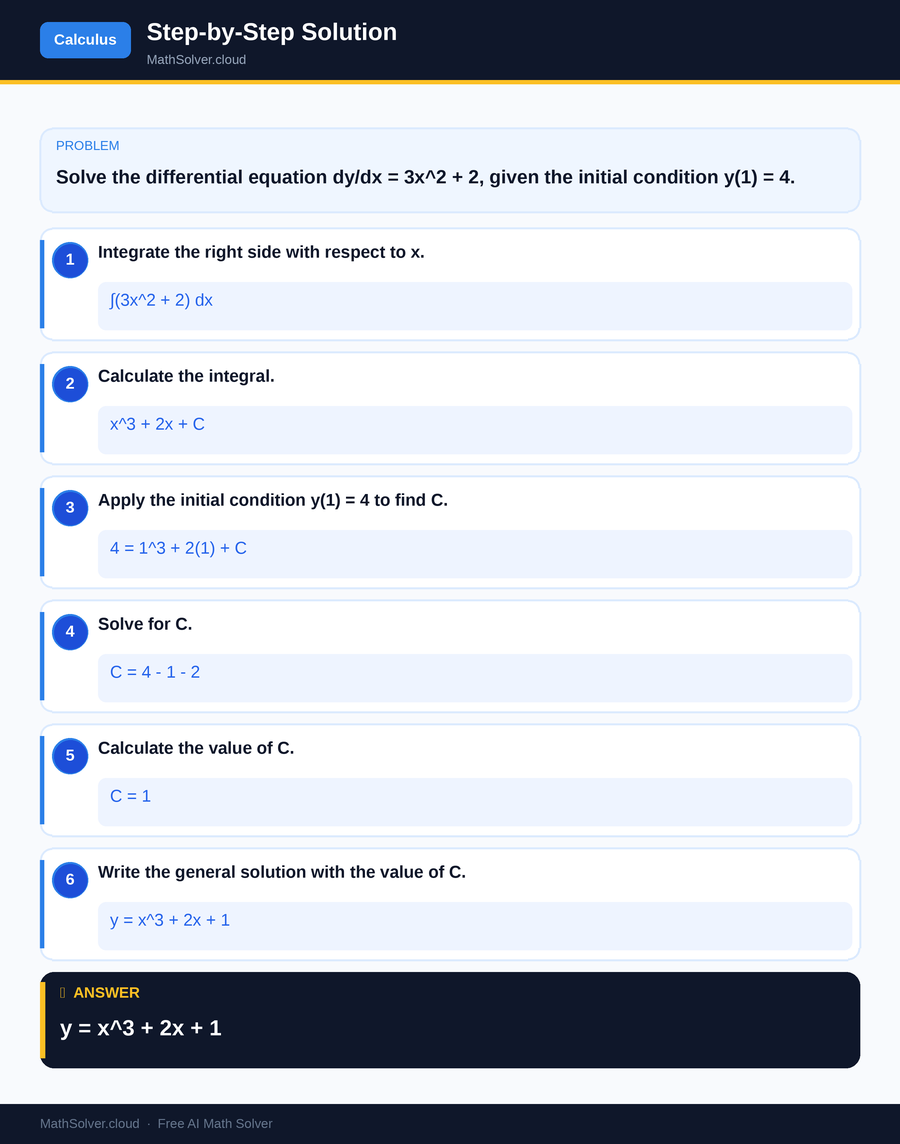
MathSolver Chrome extension solving this problem step-by-step
Example 2
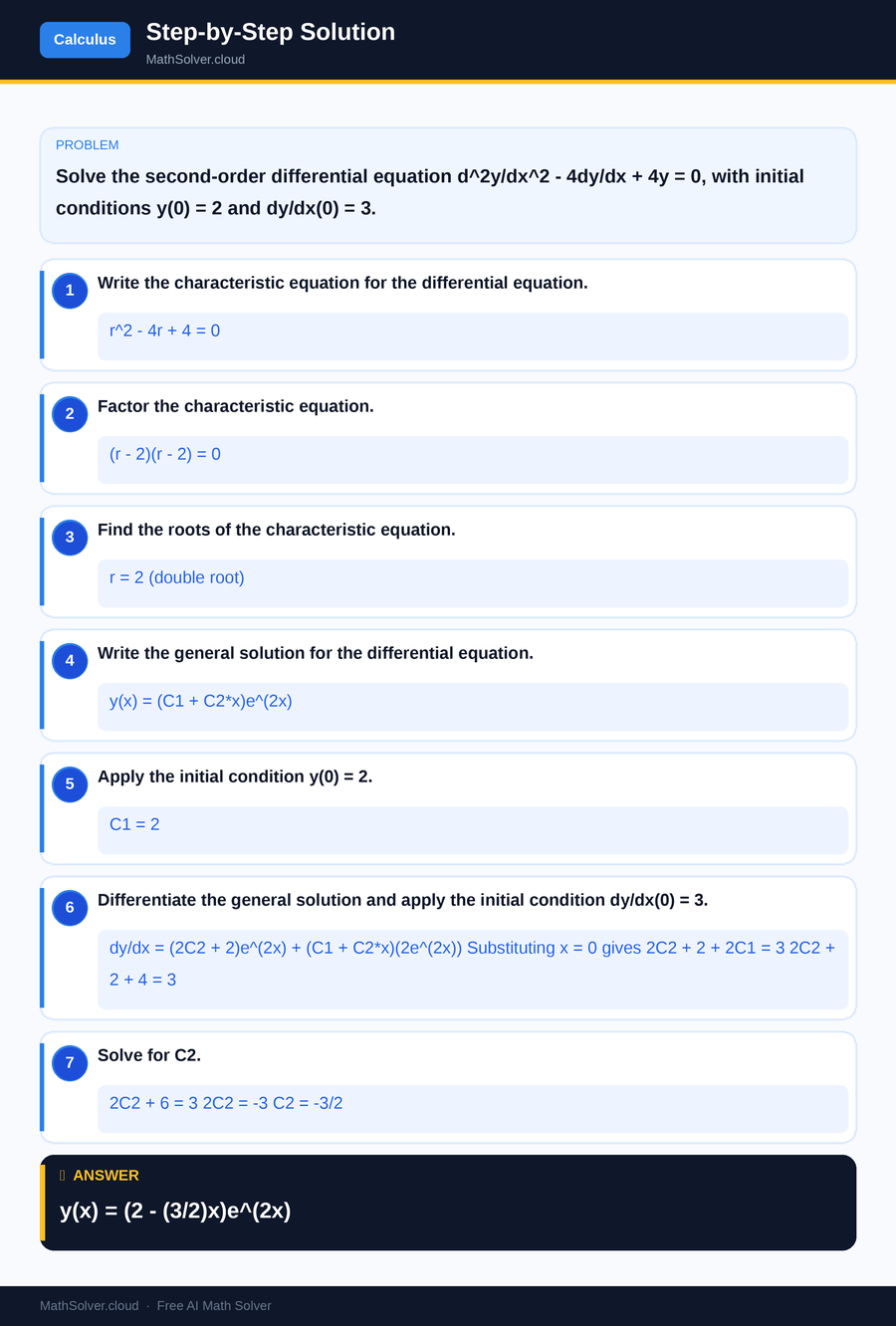
MathSolver Chrome extension solving this problem step-by-step
Common Mistakes to Avoid
One common mistake when using a differential equations calculator is entering the equation incorrectly. Always double-check your input for typographical errors, as even a small mistake can lead to an incorrect solution. Another common error is neglecting initial conditions, which can result in a general solution rather than the specific solution needed for a given problem. Make sure to input all available initial conditions accurately.
Students also often misunderstand the solution provided by the calculator. It's crucial to review the step-by-step process offered by the differential equations calculator with steps feature to ensure comprehension. Without understanding the underlying principles, students might rely too heavily on technology, hindering their learning process.
Real-World Applications
Differential equations calculators are used in various real-world applications, particularly in fields that require modeling and simulation. For example, in physics, they are crucial for solving problems related to motion, electricity, and thermodynamics. Engineers use them to model systems and processes, such as fluid dynamics and control systems.
In economics, differential equations model growth rates and changes in economic indicators over time. They are also used in biological sciences to model population dynamics and the spread of diseases. The ability to solve these equations accurately and efficiently with a differential equations calculator is invaluable in these fields.
Frequently Asked Questions
❓ What is a differential equations calculator, and how does it work?
❓ Why do students struggle with differential equations?
❓ How can AI help with a differential equations calculator?
❓ What is the difference between ordinary and partial differential equations?
❓ Can a differential equations calculator handle systems of equations?
🚀 Solve any math problem instantly
2,000+ students use MathSolver every day — join them for free
📥 Add to Chrome — It's Free