Mastering Differential Equations
📋 In this guide
A differential equation is a mathematical expression that involves functions and their derivatives. It is a crucial part of calculus and mathematical analysis, helping to describe the relationship between changing quantities. Students often struggle with differential equations because they require a strong understanding of calculus concepts and the ability to apply these concepts to solve complex problems. In this article, you will learn how to approach differential equations, solve them using step-by-step methods, and understand their significance in real-world scenarios.
Differential equations play a vital role in various fields such as physics, engineering, and economics. Many students find them challenging because they involve the synthesis of multiple calculus concepts, such as derivatives, integrals, and initial conditions. By the end of this guide, you will be equipped with the knowledge to tackle differential equations confidently and use tools like a differential equation calculator for verification.
In addition to understanding differential equations, you will also learn about related topics such as partial differential equations and ordinary differential equations. These concepts expand the breadth of applications and problem-solving techniques available to you. Let's dive in and demystify the world of differential equations, making them more approachable and less intimidating.
Step-by-Step: How to Solve Differential Equation
Step 1: Identify the Type of Differential Equation
The first step in solving a differential equation is to identify its type. Differential equations can be categorized as ordinary differential equations (ODEs) or partial differential equations (PDEs). An ODE involves functions of a single variable and their derivatives, while a PDE involves multiple variables and their partial derivatives. Understanding the type of equation helps determine the appropriate solving method.
Step 2: Determine the Order and Linearity
Once you have identified the type of differential equation, determine its order and whether it is linear or nonlinear. The order of a differential equation is the highest derivative present in the equation. A linear differential equation is one where the dependent variable and its derivatives appear linearly, without being multiplied together or raised to a power. Recognizing these characteristics helps in selecting the right solution technique.
Step 3: Choose an Appropriate Method
Depending on the type, order, and linearity of the differential equation, choose a suitable solution method. Common methods include separation of variables, integrating factors, and characteristic equations for linear differential equations. For nonlinear equations, numerical methods or specialized techniques may be required. Familiarity with these methods is crucial for solving differential equations efficiently.
Step 4: Solve and Verify the Solution
After selecting a method, solve the differential equation by following the steps specific to that method. Verify your solution by substituting it back into the original differential equation to ensure it satisfies the equation. You can use a differential equation solver or calculator to check your work and confirm the accuracy of your solution.
🤖 Stuck on a math problem?
Take a screenshot and let our AI solve it step-by-step in seconds
⚡ Try MathSolver Free →Worked Examples
Example 1
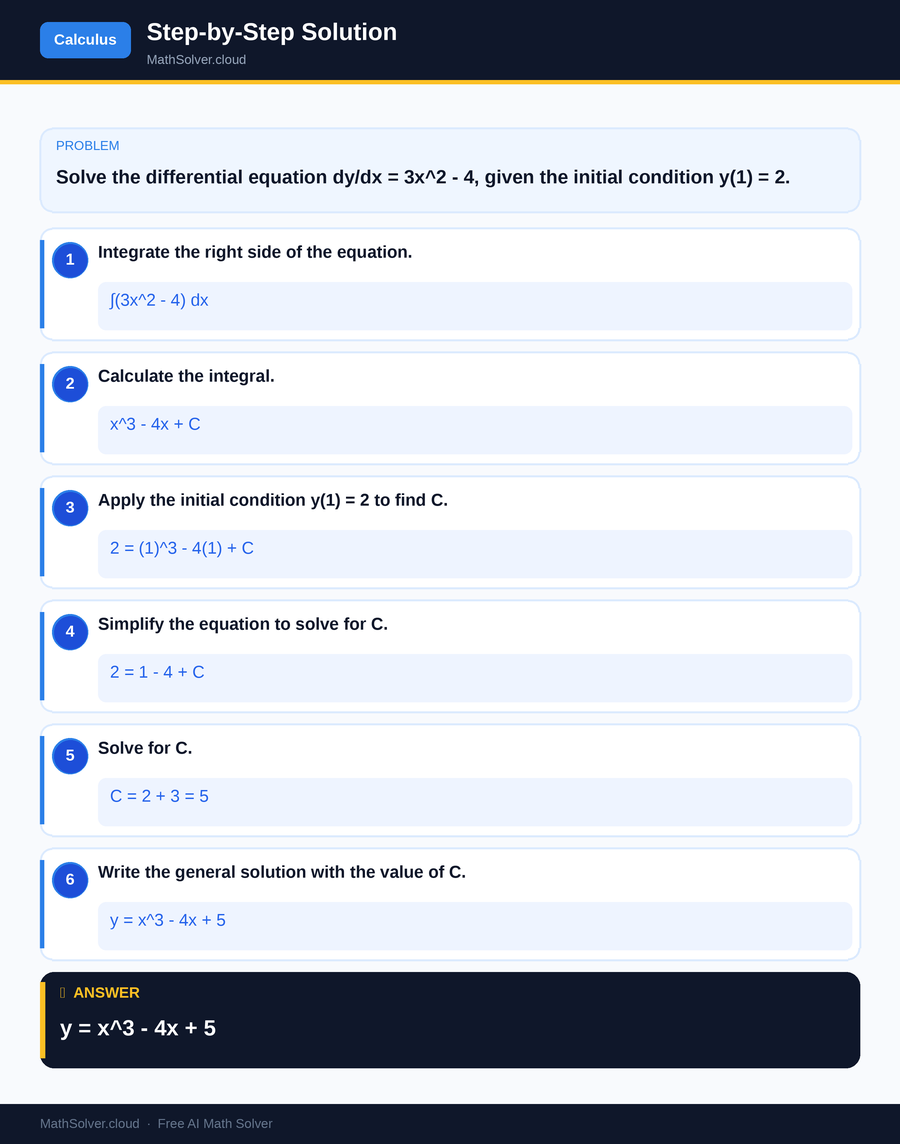
MathSolver Chrome extension solving this problem step-by-step
Example 2
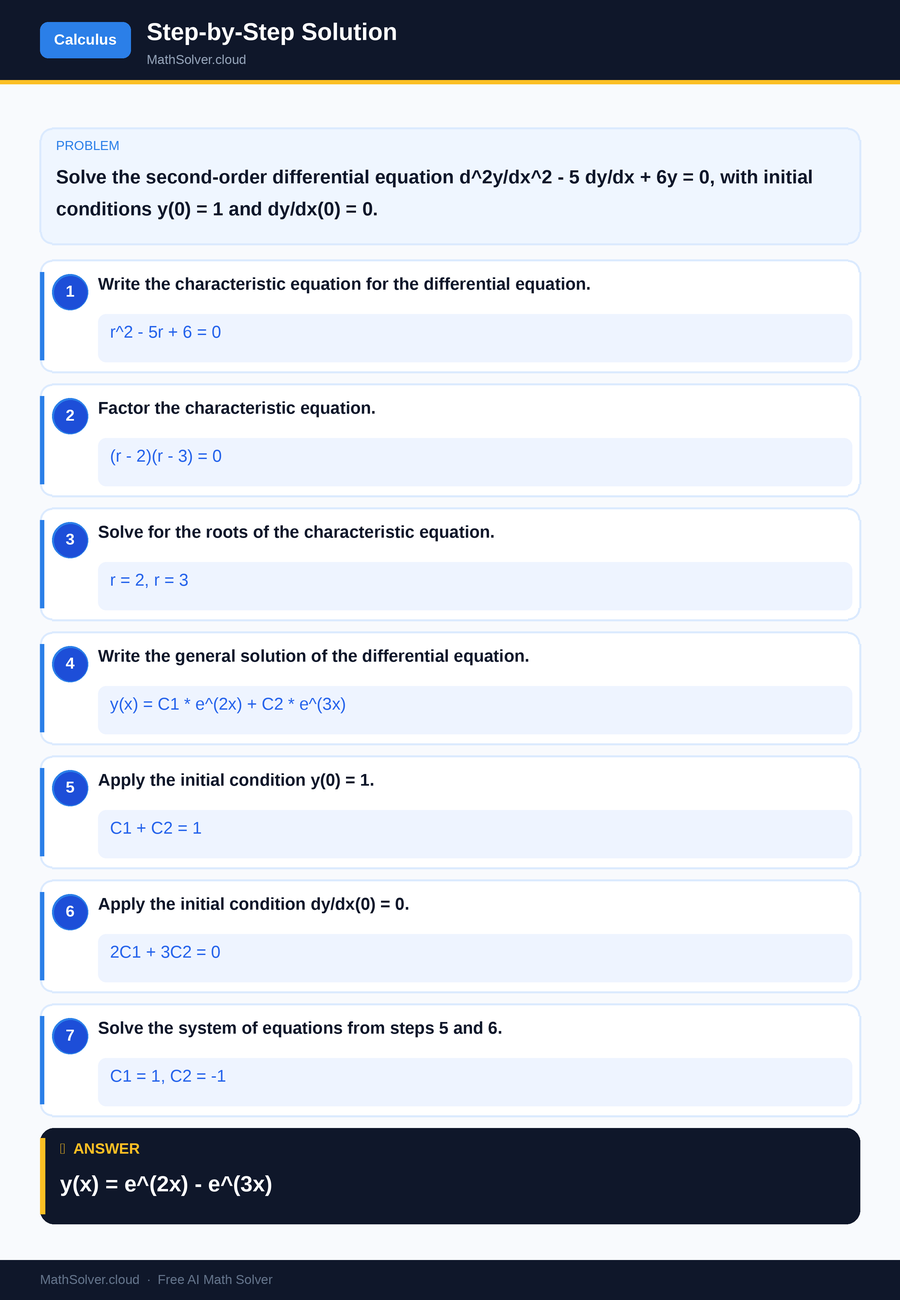
MathSolver Chrome extension solving this problem step-by-step
Common Mistakes to Avoid
One common mistake students make is misidentifying the type or order of a differential equation, leading to the application of an incorrect solution method. To avoid this, carefully analyze the equation and verify the order and type before proceeding. Another error is neglecting to apply initial or boundary conditions correctly, which can result in incomplete or incorrect solutions. Always ensure that your final solution satisfies all given conditions.
Another pitfall is computational errors during integration or algebraic manipulation. Double-check each step and use a differential equation calculator for verification. Practice is key to becoming proficient in solving differential equations, so work through multiple examples to build confidence and avoid these common mistakes.
Real-World Applications
Differential equations are used extensively in various real-world applications. In physics, they model the motion of particles and the behavior of waves, such as in the Schrödinger equation in quantum mechanics. Engineers use differential equations to design systems and predict how they will respond to different inputs, such as in control systems or structural analysis.
In biology, differential equations model population dynamics and the spread of diseases. For example, the rate of change in a population can be described using differential equations, helping biologists understand growth patterns and predict future trends. These examples highlight the importance of differential equations in understanding and solving complex problems in diverse fields.
Frequently Asked Questions
❓ What is a differential equation and why is it important?
❓ Why do students find differential equations challenging?
❓ How can AI help with differential equation problems?
❓ What is the difference between ordinary differential equations and partial differential equations?
❓ How can I improve my skills in solving differential equations?
🚀 Solve any math problem instantly
2,000+ students use MathSolver every day — join them for free
📥 Add to Chrome — It's Free