Comprehensive Guide to Differential Equation Solver
📋 In this guide
A differential equation solver is an invaluable tool for students tackling the complex world of calculus. At its core, a differential equation solver helps find solutions to equations that involve derivatives, which are fundamental in understanding how quantities change over time or space. Many students find these equations daunting due to their abstract nature and the intricate steps required to solve them. This article aims to demystify these challenges by providing a comprehensive guide on how to approach differential equations with confidence and clarity.
Differential equations are pivotal in various scientific and engineering fields, modeling everything from population growth to electrical circuits. However, their complexity can often intimidate students who are just beginning their calculus journey. By breaking down the process into manageable steps and providing detailed examples, this guide will empower learners to tackle ordinary differential equations (ODEs) and second-order differential equations with greater ease.
Throughout this article, you'll learn the fundamental concepts behind differential equations, explore step-by-step solutions, and discover how a differential equation solver with steps can simplify your learning process. Whether you're using an ordinary differential equation solver or seeking help from a tool like Wolfram Alpha differential equation solver, you'll find the guidance you need to succeed in your studies.
Step-by-Step: How to Solve Differential Equation Solver
Step 1: Understand the Type of Differential Equation
Before using a differential equation solver, it is crucial to identify the type of differential equation you are dealing with. Differential equations can be classified based on their order (first-order, second-order, etc.) and whether they are linear or nonlinear. An ordinary differential equation solver is typically used for equations involving functions of a single variable, while partial differential equations involve multiple variables.
Step 2: Choose an Appropriate Method for Solving
Once you've identified the type of differential equation, select an appropriate method for solving it. Common methods include separation of variables, integrating factors, and the characteristic equation method for linear differential equations. For instance, if you have a separable differential equation, you can rearrange it such that all terms involving y are on one side and terms involving x are on the other, allowing for straightforward integration.
Step 3: Solve the Equation Step-by-Step
With the method chosen, it's time to solve the equation step-by-step. Begin by applying the selected method to derive a general solution. This involves integrating both sides of the equation and applying any initial conditions given in the problem. Initial conditions are crucial as they allow you to determine the constants of integration, yielding a specific solution to the problem.
Step 4: Verify Your Solution
After obtaining a solution, it's important to verify its correctness. Plug your solution back into the original differential equation to ensure it satisfies the equation. This step is essential for confirming that your solution is accurate and that no errors were made during the solving process. If the solution holds true when substituted back into the equation, you have successfully solved the differential equation.
🤖 Stuck on a math problem?
Take a screenshot and let our AI solve it step-by-step in seconds
⚡ Try MathSolver Free →Worked Examples
Example 1
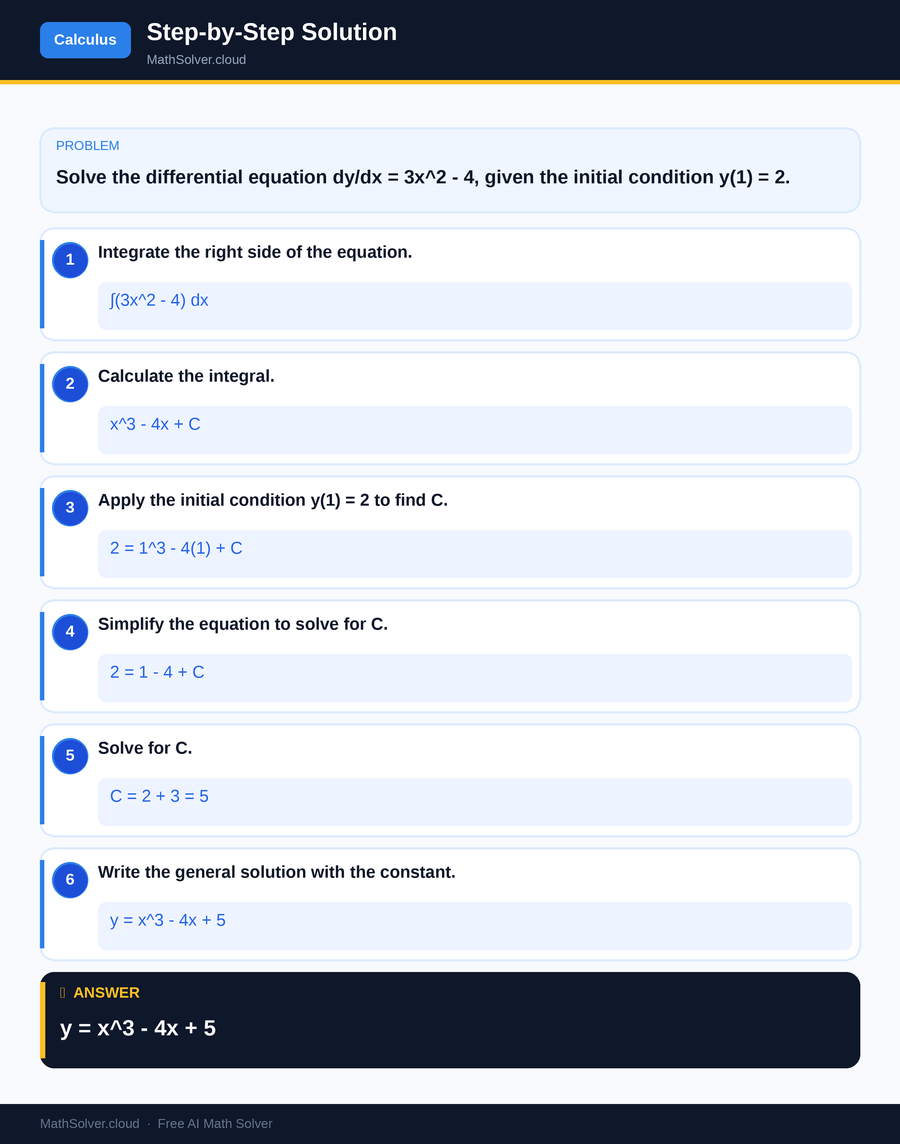
MathSolver Chrome extension solving this problem step-by-step
Example 2
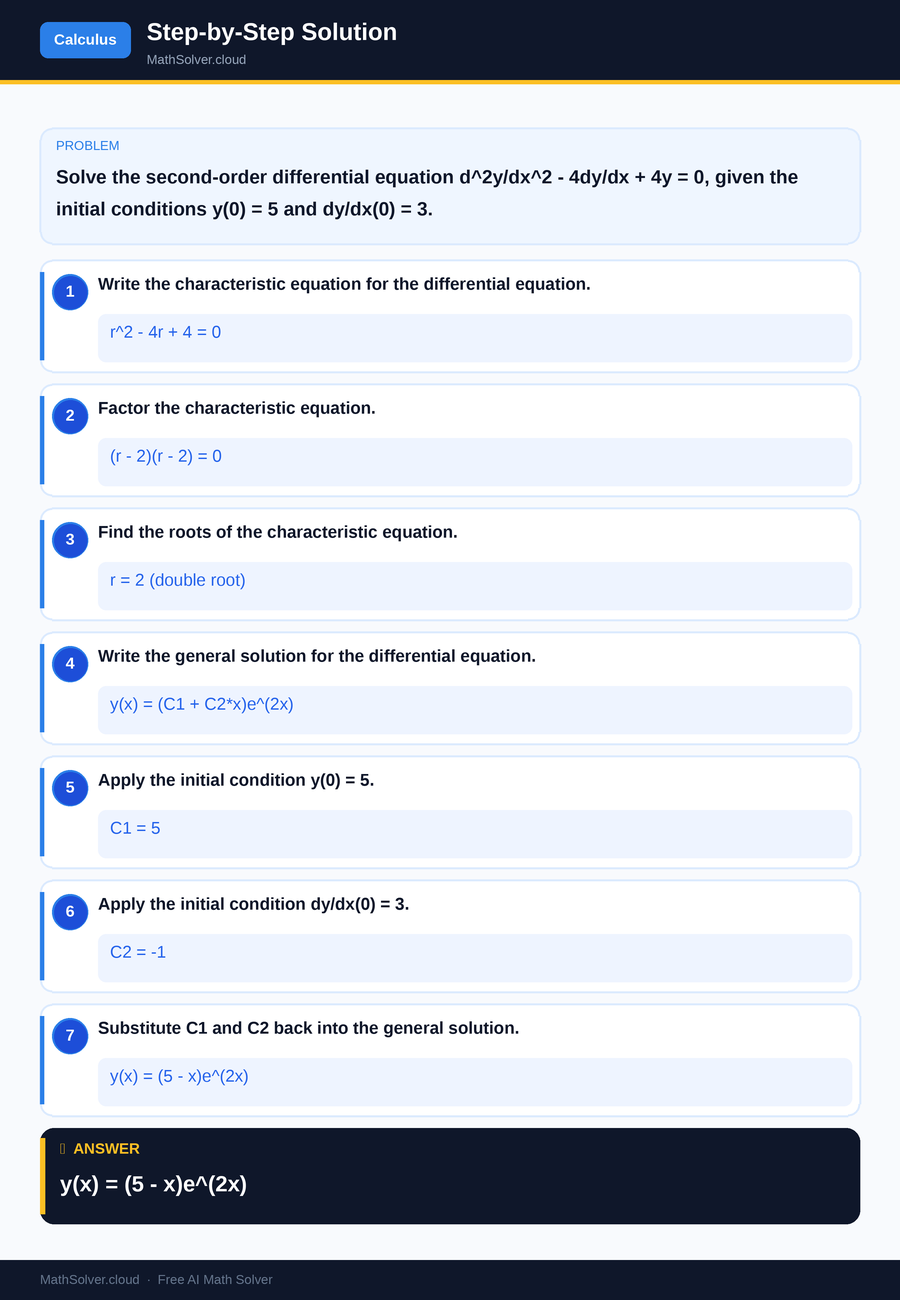
MathSolver Chrome extension solving this problem step-by-step
Common Mistakes to Avoid
One common mistake students make when using a differential equation solver is failing to correctly apply initial conditions. This oversight can lead to incorrect solutions because the constants of integration are not properly determined. Always ensure you accurately incorporate initial conditions into your solution process, as they are essential for finding specific, rather than general, solutions.
Another frequent error is misidentifying the type of differential equation or applying an inappropriate solving method. It's crucial to thoroughly understand the characteristics of the equation you are working with to choose the correct method. Misapplication of techniques can lead to incorrect or overly complicated solutions. Familiarize yourself with different solving methods and practice identifying which is suitable for a given equation.
Real-World Applications
Differential equation solvers have a wide range of real-world applications. In physics, they are used to model the motion of objects under the influence of forces, such as in Newton's second law of motion. Engineers use them to analyze electrical circuits, where they describe the relationship between current and voltage over time.
In biology, differential equations can model population dynamics, such as how populations grow or decline in response to environmental factors. They are also used in economics to model the behavior of markets, where they help in understanding how economic variables change over time. These examples highlight the importance of mastering differential equation solvers for practical, real-world problem-solving.
Frequently Asked Questions
❓ What is a differential equation solver and how does it work?
❓ Why are differential equations so difficult for students to grasp?
❓ How can AI help with differential equation solver?
❓ What is the difference between an ordinary differential equation solver and other solvers?
❓ Can differential equation calculators replace traditional solving methods?
🚀 Solve any math problem instantly
2,000+ students use MathSolver every day — join them for free
📥 Add to Chrome — It's Free