How to Define Ordinary Differential Equation
📋 In this guide
When we define ordinary differential equation, we are referring to a mathematical equation that involves functions and their derivatives. Ordinary differential equations (ODEs) are essential in modeling various real-world phenomena, from the growth of populations to the motion of springs. However, many students find ODEs challenging. The difficulty often arises from the abstract nature of derivatives and the complexity involved in solving these equations, especially when higher-order derivatives are involved. Throughout this article, you'll unravel the mystery behind ordinary differential equations, learning how to define them, solve them, and understand their applications.
Understanding how to define ordinary differential equations is crucial for students embarking on advanced studies in mathematics, engineering, and physics. By mastering ODEs, students can better comprehend how different systems evolve over time and how to predict future behavior based on current conditions. This understanding is not only academically rewarding but also practically useful in various scientific and engineering fields.
In this comprehensive guide, we will start by defining ordinary differential equations and proceed to break down the main formula associated with them. We will then walk you through a step-by-step guide on solving these equations, providing worked examples to illustrate the process. Additionally, we will highlight common mistakes students make, discuss real-world applications, and address frequently asked questions. By the end of this article, you will be equipped with the knowledge to tackle ordinary differential equations confidently.
Step-by-Step: How to Solve Define Ordinary Differential Equation
Step 1: Identifying the Order and Degree
The first step in solving an ordinary differential equation is to identify its order and degree. The order is the highest derivative present in the equation. For example, in the equation d^2y/dx^2 + 3dy/dx + 2y = 0, the highest derivative is d^2y/dx^2, making it a second-order ODE. The degree, on the other hand, is the power of the highest derivative if the equation is polynomial in derivatives. In many cases, the degree is one, making it a linear differential equation.
Step 2: Classifying the Differential Equation
Once the order and degree are known, the next step is to classify the differential equation. This involves determining whether the equation is linear or nonlinear. A linear ordinary differential equation is one in which the dependent variable and its derivatives appear linearly, meaning they are not multiplied or divided by each other or raised to any power other than one. Nonlinear ODEs involve terms like y^2 or dy/dx * y. Understanding the classification helps decide the appropriate method for solving the equation.
Step 3: Selecting a Solution Method
With the classification in hand, the next step is to select a suitable method for solving the ODE. Common methods include separation of variables, integrating factors, and characteristic equations for linear ODEs. Nonlinear ODEs might require numerical methods or more advanced techniques. For example, if you have a first-order linear ODE like dy/dx + P(x)y = Q(x), an integrating factor can be used to transform it into an easily integrable form.
Step 4: Solving and Verifying the Solution
After selecting a method, proceed with solving the equation step-by-step. Ensure each step is logically connected to the previous one. Once a solution is found, it's crucial to verify it by substituting back into the original equation. Verification will confirm that the solution satisfies the ODE. Additionally, consider any initial conditions provided, as these will help determine the constants of integration and yield a specific solution to the problem.
🤖 Stuck on a math problem?
Take a screenshot and let our AI solve it step-by-step in seconds
⚡ Try MathSolver Free →Worked Examples
Example 1
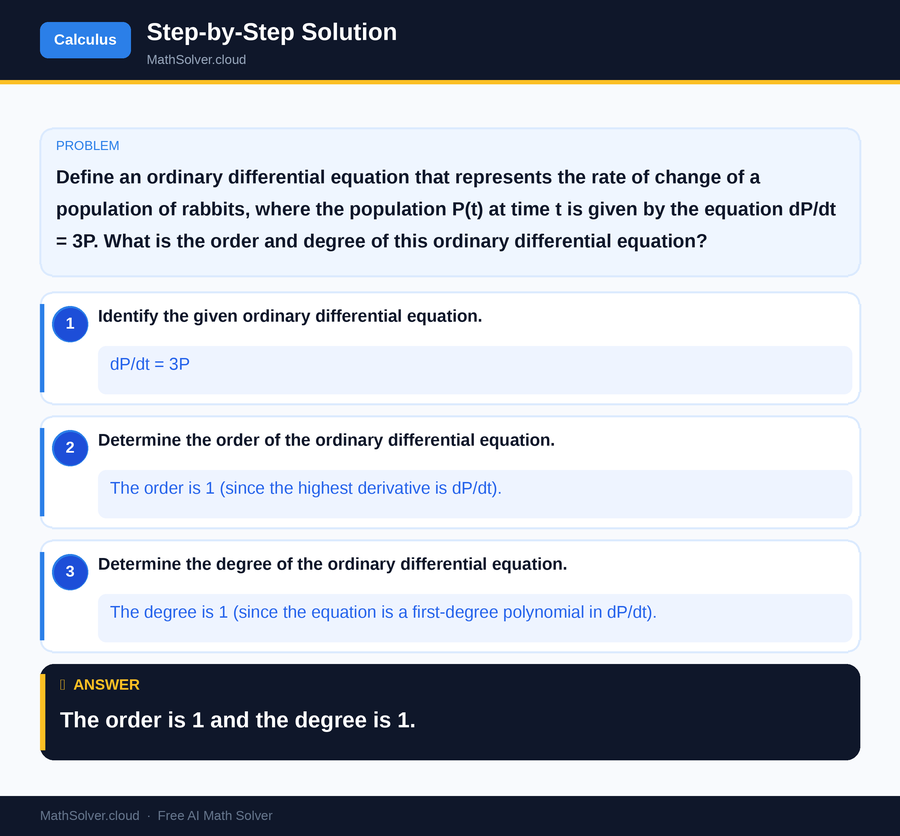
MathSolver Chrome extension solving this problem step-by-step
Example 2
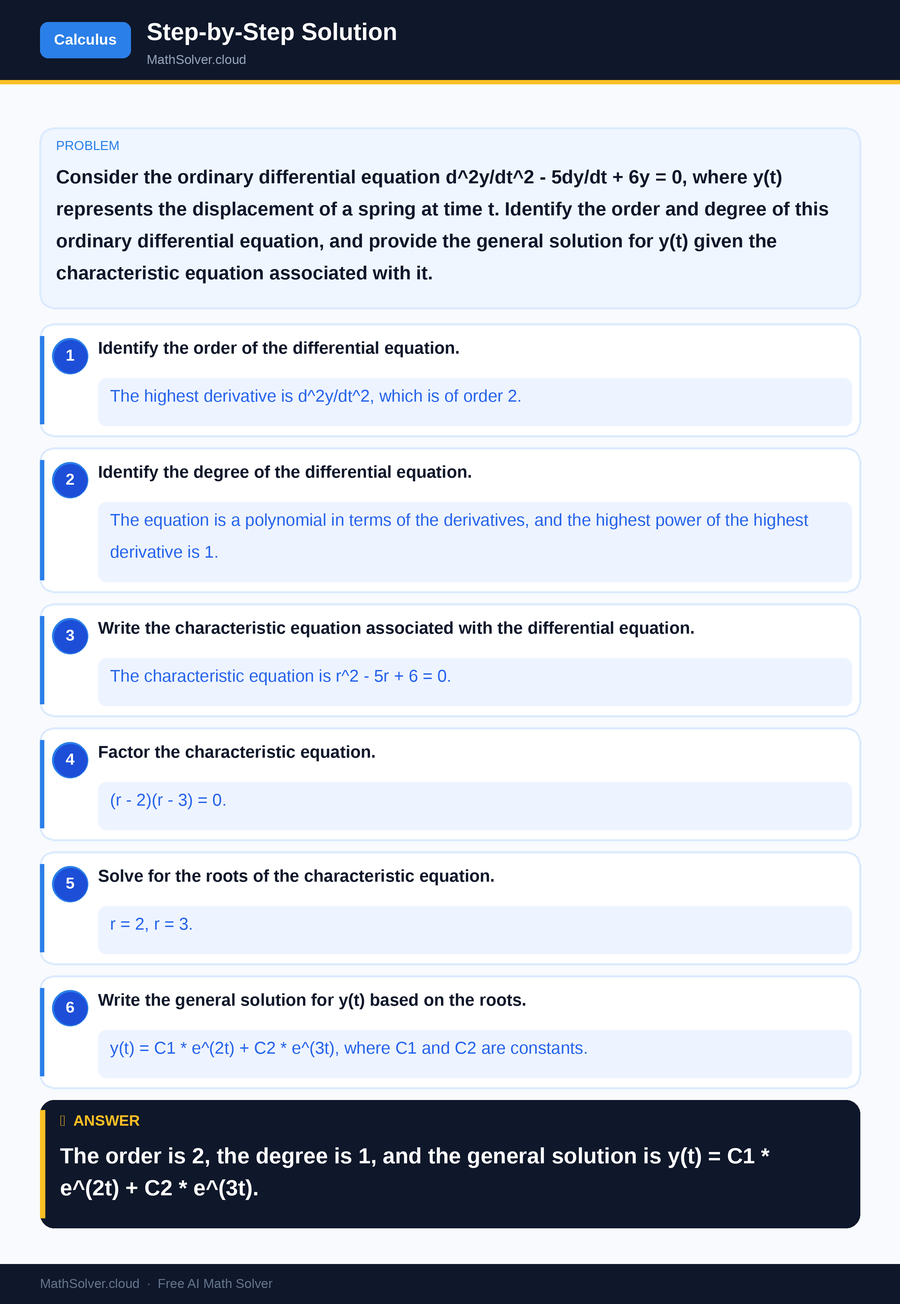
MathSolver Chrome extension solving this problem step-by-step
Common Mistakes to Avoid
One common mistake when working with ordinary differential equations is misidentifying the order and degree. Students often confuse the highest derivative with the highest power of a derivative. Remember, the order relates to the highest derivative, while the degree concerns the power of that derivative when the equation is polynomial. Another mistake is neglecting to verify solutions. Always substitute your solution back into the original equation to ensure it satisfies the ODE. This verification step is crucial to avoid incorrect conclusions.
Additionally, students sometimes apply incorrect solution methods. For instance, using separation of variables on a non-separable equation leads to errors. Ensure the method chosen matches the classification of the ODE. Linear ODEs often have straightforward methods like integrating factors or characteristic equations, while nonlinear ODEs might require more advanced techniques or numerical methods.
Real-World Applications
Ordinary differential equations have a multitude of real-world applications. In biology, they model population dynamics, such as the growth of bacterial cultures or the spread of diseases. For example, the logistic growth model uses an ODE to describe how populations grow rapidly and then stabilize as they reach carrying capacity. In engineering, ODEs are critical in analyzing systems like electrical circuits or mechanical vibrations, where they help predict system behavior over time.
In physics, ODEs are used to model motion, such as the behavior of springs and pendulums, where the displacement, velocity, and acceleration are interrelated through derivatives. Understanding how to define ordinary differential equations allows scientists and engineers to simulate and optimize these systems, leading to innovations in technology and improved processes in various industries.
Frequently Asked Questions
❓ How do you define ordinary differential equation?
❓ What is the difference between ordinary and partial differential equations?
❓ How can AI help with define ordinary differential equation?
❓ What are some common methods to solve ordinary differential equations?
❓ How are ordinary differential equations used in engineering?
🚀 Solve any math problem instantly
2,000+ students use MathSolver every day — join them for free
📥 Add to Chrome — It's Free