Mastering Calculus Theorems
📋 In this guide
Calculus theorems are at the heart of understanding how calculus connects with both the real world and theoretical mathematics. These theorems, such as the Intermediate Value Theorem, the Mean Value Theorem, and the Fundamental Theorem of Calculus, provide the foundational principles that allow us to analyze changes and behavior in various functions. Students often find calculus theorems challenging because they require a deep understanding of both algebraic manipulation and conceptual reasoning. However, mastering these theorems is crucial for success in advanced mathematics and related fields.
The struggle with calculus theorems often stems from the abstract nature of the concepts involved. Many students find it difficult to visualize what the theorems imply and how to apply them to solve problems. This difficulty is compounded by the need to thoroughly understand prior mathematical concepts, such as limits and continuity, which are prerequisites for applying calculus theorems effectively. In this article, we aim to demystify calculus theorems, providing clear explanations and step-by-step guidance to help students gain confidence in using these powerful tools.
By the end of this article, you'll have a solid understanding of how to apply calculus theorems to solve problems and interpret results in meaningful ways. We'll explore essential formulas, work through examples, and highlight common pitfalls to avoid. You'll also discover how calculus theorems are used in real-world applications, enhancing your appreciation of their practical significance. This guide serves as a comprehensive resource for students seeking to deepen their understanding of calculus, complementing resources such as our complete Calculus guide at MathSolver.cloud.
Step-by-Step: How to Solve Calculus Theorems
Step 1: Understanding Continuity and Intervals
The first step in applying calculus theorems like the Intermediate Value Theorem is to ensure that the function in question is continuous on the given interval. A function is continuous on an interval if there are no breaks, jumps, or holes in its graph within that interval. To verify continuity, check if the function is defined at every point in the interval and that the limit of the function as it approaches any point within the interval is equal to the function's value at that point.
Step 2: Identifying Suitable Intervals
Once continuity is established, the next step is to identify the interval [a, b] over which you will apply the theorem. This interval should be chosen based on where you want to analyze the function's behavior or locate roots. For the Intermediate Value Theorem, ensure that the function values at the endpoints, f(a) and f(b), are of opposite signs if you are looking for a root. This indicates that the function crosses the x-axis within that interval.
Step 3: Applying the Theorem
With continuity confirmed and the interval selected, apply the calculus theorem by substituting the interval's endpoints into the function. Calculate the function values at these points. For the Intermediate Value Theorem, if f(a) and f(b) are of opposite signs, you can conclude that there is at least one root in the interval. For the Mean Value Theorem, you'll calculate the derivative and the average rate of change over the interval to find a specific value c where the derivative equals the average rate.
Step 4: Interpreting Results
The final step is to interpret the results of applying the theorem. For the Intermediate Value Theorem, identifying a root confirms the function's behavior within the interval. For other theorems like the Mean Value Theorem, the result provides insights into the function's rate of change at specific points. Understanding these interpretations allows you to make informed predictions about the function's behavior beyond the interval analyzed.
🤖 Stuck on a math problem?
Take a screenshot and let our AI solve it step-by-step in seconds
⚡ Try MathSolver Free →Worked Examples
Example 1
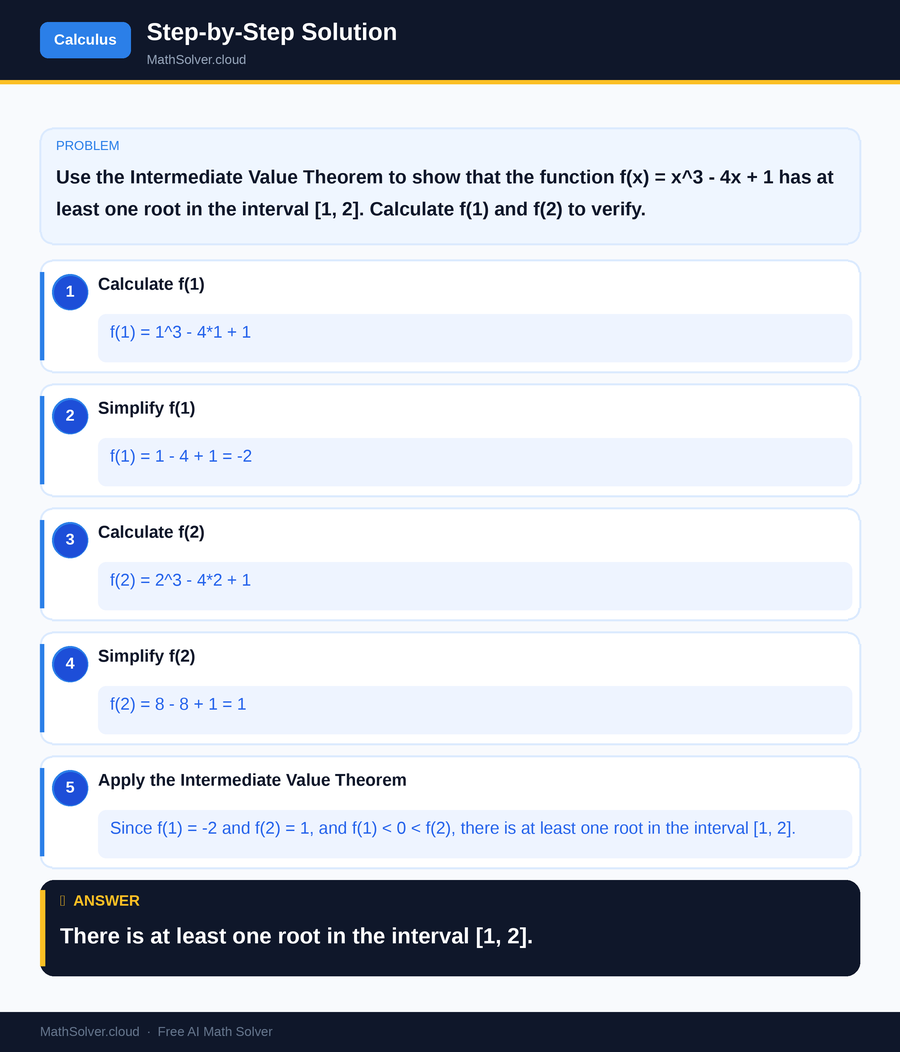
MathSolver Chrome extension solving this problem step-by-step
Example 2
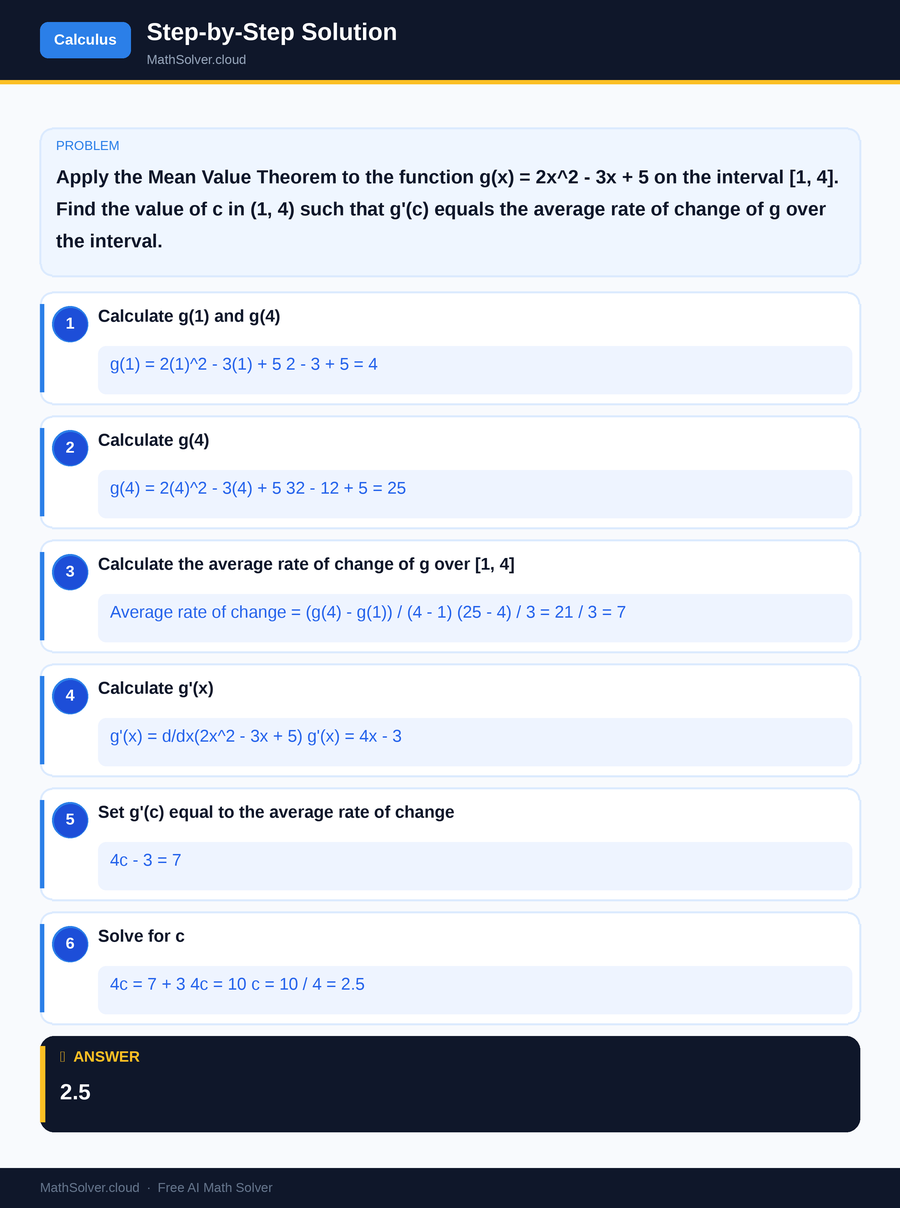
MathSolver Chrome extension solving this problem step-by-step
Common Mistakes to Avoid
One common mistake when applying calculus theorems is failing to ensure the function is continuous over the interval of interest. This oversight can lead to incorrect conclusions, as discontinuous functions do not meet the criteria necessary for the theorems' application. To avoid this, always verify the function's continuity within the specified interval by checking for breaks or undefined points.
Another frequent error is miscalculating the function values at the interval's endpoints, particularly with sign changes. This is crucial when applying the Intermediate Value Theorem, as incorrect signs can lead to false results about the existence of roots. Double-check calculations and ensure accuracy to prevent such mistakes, thereby ensuring reliable conclusions.
Real-World Applications
Calculus theorems have numerous real-world applications, particularly in fields requiring precise predictions and analyses of change. For instance, in physics, the Mean Value Theorem is used to understand the behavior of moving objects, allowing for calculations of average velocity and acceleration over time. This application is essential in designing efficient transportation systems and analyzing motion dynamics.
In economics, calculus theorems, such as the Intermediate Value Theorem, play a crucial role in optimizing production and cost functions. By determining critical points where changes occur, businesses can make informed decisions about resource allocation and pricing strategies. These applications highlight the practical significance of calculus theorems beyond mere academic exercises.
Frequently Asked Questions
❓ What are calculus theorems and why are they important?
❓ Why do students often find calculus theorems difficult?
❓ How can AI help with calculus theorems?
❓ What are some common pitfalls to avoid when applying calculus theorems?
❓ How are calculus theorems applied in technology and engineering?
🚀 Solve any math problem instantly
2,000+ students use MathSolver every day — join them for free
📥 Add to Chrome — It's Free