A Comprehensive Guide to Solving Calculus Problems
📋 In this guide
Calculus problems are a key component of advanced mathematics, dealing primarily with the concepts of derivatives and integrals. These problems form the foundation for understanding changes and motion in various scientific fields, such as physics, engineering, and economics. Calculus can often be daunting for students because it requires a different way of thinking compared to algebra or geometry. The abstract nature of calculus can make it challenging to visualize and understand the concepts, leading to difficulties in solving problems.
Students often struggle with calculus problems due to the complexity of the operations involved and the precision required in calculations. Unlike pre calculus problems, which focus on foundational mathematical concepts, calculus introduces new ideas that require a higher level of reasoning and problem-solving skills. From understanding limits to mastering integration, each step in calculus builds upon the previous ones, making it essential to thoroughly grasp each concept to succeed.
In this article, we'll explore calculus problems, offering a step-by-step guide to solve them effectively. Whether you're tackling hard calculus problems or preparing for AP Calculus exams, this guide will provide you with the tools and techniques needed to approach calculus with confidence. By the end, you'll have a clearer understanding of how to handle difficult calculus problems and where to find calculus problems and answers to further enhance your learning.
Step-by-Step: How to Solve Calculus Problems
Step 1: Understand the Problem
The first step in solving calculus problems is to thoroughly understand what is being asked. Read the problem carefully and identify whether it requires differentiation, integration, or a combination of both. Determine the given function and any specific points or intervals you need to evaluate. For example, if you are dealing with a problem that asks for the derivative at a specific point, make sure you note down the function and the point accurately.
Step 2: Choose the Right Method
Once you have a clear understanding of the problem, decide on the appropriate method to solve it. For differentiation, consider using basic rules like the power rule, product rule, or chain rule, depending on the complexity of the function. For integration, choose between definite and indefinite integrals, and apply techniques like substitution or integration by parts if necessary. Identifying the right method is crucial for simplifying hard calculus problems.
Step 3: Execute the Calculation
With the method chosen, proceed to perform the calculations. Pay close attention to each step to avoid common errors. For differentiation, apply the rules systematically to find the derivative. For integration, follow the integration process step-by-step, including any necessary simplifications. Ensure your calculations are neat and orderly, as this will help prevent mistakes and make it easier to review your work.
Step 4: Verify the Solution
After completing the calculations, take a moment to verify your solution. For derivatives, check the result by substituting the point back into the derivative to ensure it matches the problem's requirements. For integrals, consider differentiating your result to see if it returns to the original function. This verification step is essential for confirming the accuracy of your solution and solidifying your understanding of difficult calculus problems.
🤖 Stuck on a math problem?
Take a screenshot and let our AI solve it step-by-step in seconds
⚡ Try MathSolver Free →Worked Examples
Example 1
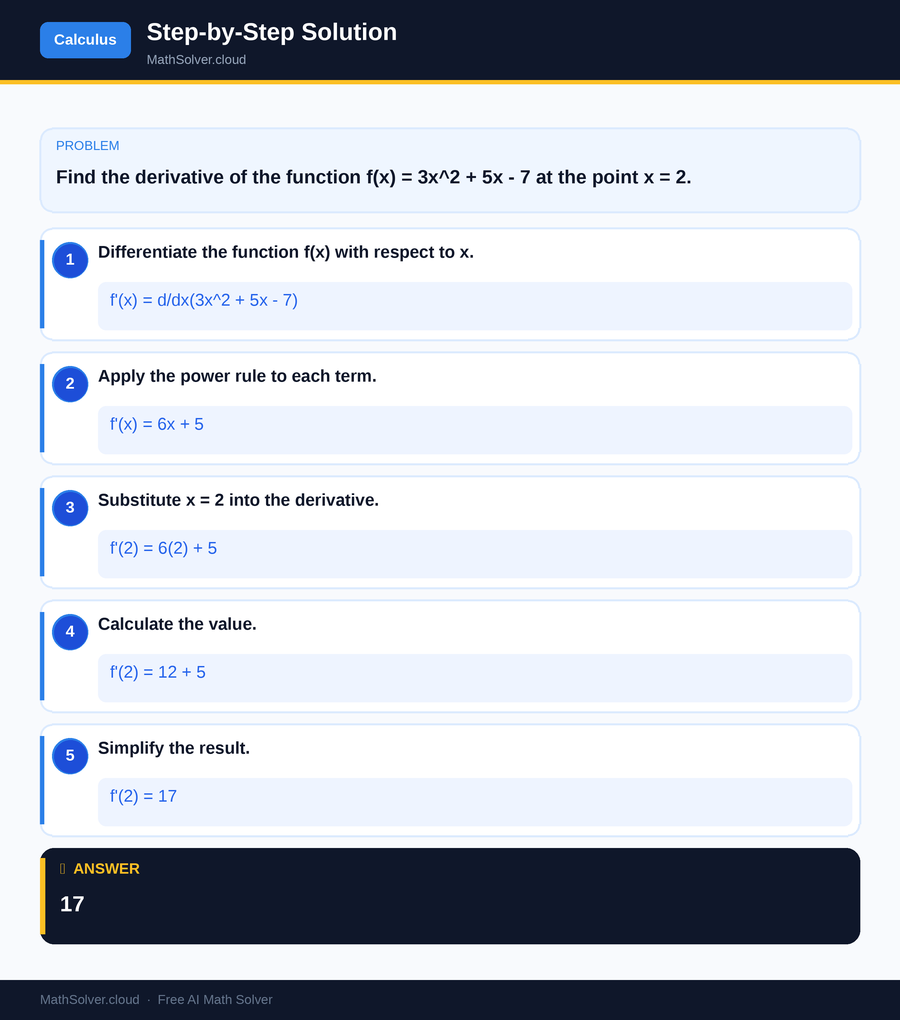
MathSolver Chrome extension solving this problem step-by-step
Example 2
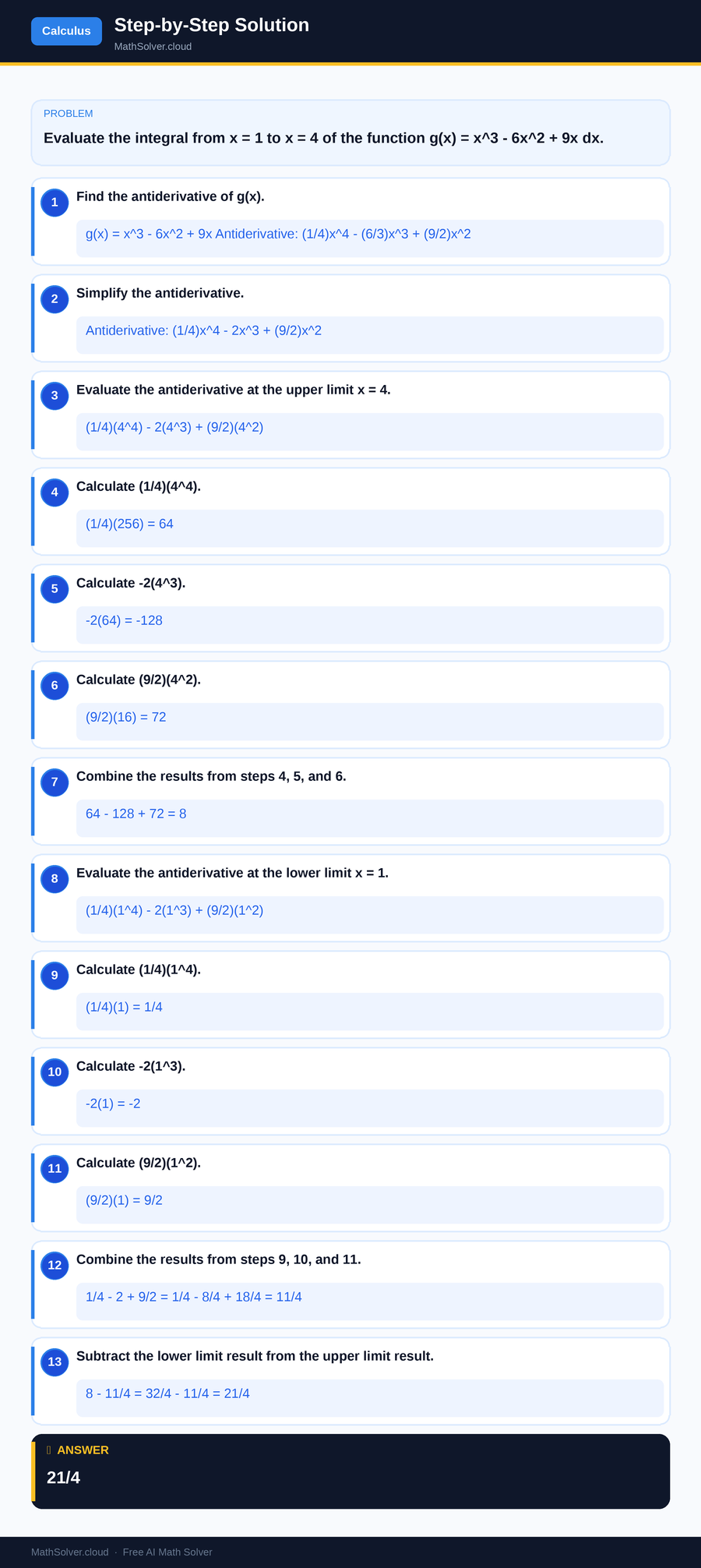
MathSolver Chrome extension solving this problem step-by-step
Common Mistakes to Avoid
One common mistake in solving calculus problems is neglecting the chain rule when differentiating composite functions. This can lead to incorrect derivatives and downstream errors in calculations. To avoid this, ensure you identify composite functions and apply the chain rule appropriately by multiplying the derivative of the outer function by the derivative of the inner function.
Another frequent error is not applying the limits of integration correctly when evaluating definite integrals. Students might forget to substitute both the upper and lower limits into the antiderivative or make arithmetic errors in simplification. To prevent this, carefully substitute each limit into the antiderivative and perform the subtraction accurately, double-checking each step to ensure correctness.
Real-World Applications
Calculus problems are not just academic exercises; they have numerous real-world applications that impact various fields. In physics, calculus is essential for understanding motion, forces, and energy. Engineers use calculus to design and analyze systems, from determining the stress on materials to optimizing the efficiency of engines and circuits.
In the world of economics, calculus helps model and predict changes in markets and economic trends. Businesses use calculus to calculate profit maximization and cost minimization strategies. Additionally, calculus plays a critical role in computer science, particularly in algorithms and machine learning, where it helps optimize functions and understand changes in data patterns.
Frequently Asked Questions
❓ What are some common calculus problems students face?
❓ Why are calculus problems considered difficult?
❓ How can AI help with calculus problems?
❓ What is the role of integration in calculus problems?
❓ How can students improve their skills in solving calculus problems?
🚀 Solve any math problem instantly
2,000+ students use MathSolver every day — join them for free
📥 Add to Chrome — It's Free