Exploring the World of Calculus Math
📋 In this guide
Calculus math is a branch of mathematics that focuses on the study of rates of change and the accumulation of quantities. It is a fundamental subject that serves as a gateway to more advanced topics in mathematics and the sciences. Many students find calculus math challenging due to its abstract concepts and the necessity for strong foundational knowledge in algebra and trigonometry. However, with the right approach and understanding, learning calculus can be highly rewarding.
Understanding calculus math is crucial for students pursuing careers in fields such as engineering, physics, computer science, and economics. It provides the tools to model and solve real-world problems related to change and motion. In this article, we will explore the basics of calculus math, explain key formulas, and provide step-by-step guides to solving common problems. By the end of this article, you will have a clearer understanding of how to approach calculus math problems and apply calculus concepts in various scenarios.
While calculus math may appear daunting at first, breaking it down into manageable parts can make it more accessible. We will discuss the core concepts of differentiation and integration, provide worked examples, and highlight common mistakes to avoid. Additionally, we'll explore how calculus is used in real-world applications, demystifying its complexity and making it more relatable. Let's dive into the world of calculus math and unlock its potential together!
Step-by-Step: How to Solve Calculus Math
Step 1: Understanding Limits
The concept of limits is foundational in calculus math. A limit examines how a function behaves as it approaches a particular point. To find a limit, you analyze the function's behavior from both sides of the point. For example, the limit of f(x) as x approaches a value can determine the continuity of the function at that point. Practicing limit problems is essential for mastering calculus.
Step 2: Differentiation Basics
Differentiation is a key process in calculus math that involves finding the derivative of a function. It tells us how a function is changing at any point. To differentiate a function, apply rules such as the power rule, product rule, and chain rule. For instance, the derivative of x^n is n*x^(n-1). Differentiation enables us to understand and predict the behavior of dynamic systems.
Step 3: Introduction to Integration
Integration is the reverse process of differentiation and is crucial for finding areas under curves and solving accumulation problems. The integral of a function f(x) with respect to x is its antiderivative, represented by the integral symbol ∫. To solve integration problems, you can use techniques such as substitution and integration by parts. For example, the integral of x^n dx is (x^(n+1))/(n+1) + C, where C is the constant of integration.
Step 4: Applying the Fundamental Theorems
The Fundamental Theorems of Calculus bridge the concepts of differentiation and integration. The First Fundamental Theorem states that if f is continuous on [a, b], then the integral from a to b of f(x) dx equals F(b) - F(a), where F is any antiderivative of f. The Second Fundamental Theorem allows us to evaluate definite integrals, emphasizing the connection between derivatives and integrals.
🤖 Stuck on a math problem?
Take a screenshot and let our AI solve it step-by-step in seconds
⚡ Try MathSolver Free →Worked Examples
Example 1
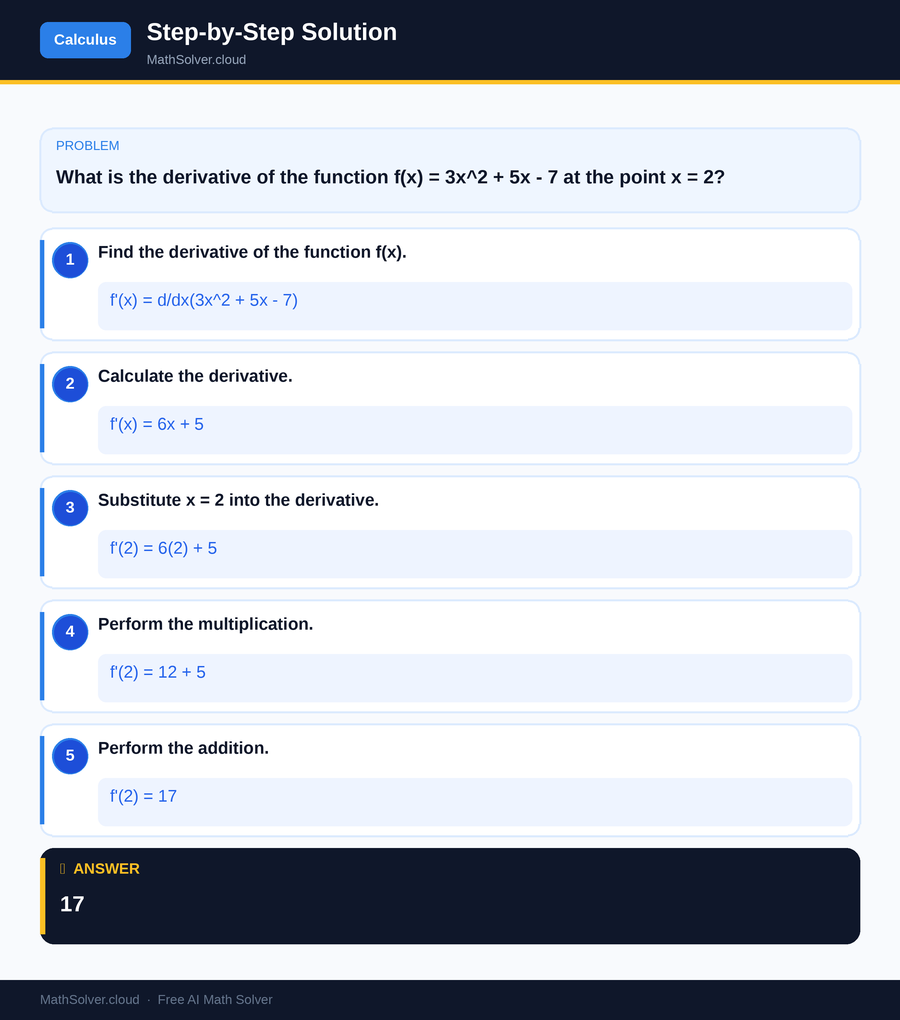
MathSolver Chrome extension solving this problem step-by-step
Example 2

MathSolver Chrome extension solving this problem step-by-step
Common Mistakes to Avoid
One common mistake in calculus math is failing to apply the rules of differentiation and integration correctly. Students often forget to use the chain rule in differentiation or make errors in the order of operations. To avoid this, always double-check your work and break down complex problems into smaller, manageable steps.
Another frequent error is neglecting the constant of integration when solving indefinite integrals. This oversight can lead to incorrect final answers. Remember to include the constant of integration, C, whenever you find an antiderivative, as it represents an entire family of solutions.
Real-World Applications
Calculus math is not just theoretical; it has numerous real-world applications. In physics, calculus is used to model motion and change, allowing scientists to predict how objects will move under various forces. Engineers use calculus to design and optimize systems, such as calculating the stress on a bridge or determining the efficiency of a new engine design.
In economics, calculus helps in understanding and forecasting market trends by analyzing marginal costs and revenues. The principles of calculus are also used in medicine, particularly in modeling the spread of diseases and optimizing dosages for treatments. These examples illustrate how calculus math is integral to solving practical problems in diverse fields.
Frequently Asked Questions
❓ What is calculus math?
❓ Why do students struggle with calculus math?
❓ How can AI help with calculus math?
❓ What is the difference between differential equations and calculus?
❓ How can I improve my calculus skills?
🚀 Solve any math problem instantly
2,000+ students use MathSolver every day — join them for free
📥 Add to Chrome — It's Free