Demystifying Calculus Equations
📋 In this guide
Calculus equations form the backbone of advanced mathematics, serving as essential tools for understanding change and motion. Students often find themselves wrestling with calculus equations due to their abstract nature and the conceptual leap required from algebra or pre calculus equations. The challenge lies in grasping both the mechanics and the conceptual understanding necessary to tackle calculus equations effectively. However, with some guidance and practice, you can transform these challenges into stepping stones towards mastering calculus.
In this article, we will demystify calculus equations by breaking down their components and providing clear, step-by-step solutions to common problems. You'll learn about derivatives and integrals, two fundamental concepts in calculus, and how to apply them in various contexts. By the end of this guide, you'll be more confident in your ability to handle calculus equations, both in academic settings and real-world applications.
We will also explore some of the coolest looking calculus equations and offer tips for avoiding common pitfalls. Whether you're preparing for AP Calculus exams or simply looking to enhance your mathematical toolkit, this comprehensive guide is designed to support your learning journey. We invite you to explore our complete Calculus guide for further resources and support.
Step-by-Step: How to Solve Calculus Equations
Step 1: Understanding the Derivative
The first step in mastering calculus equations is to understand the concept of the derivative. The derivative measures how a function changes as its input changes. For example, if you have a function that describes the position of a car over time, the derivative of that function will give you the car's velocity. Start by practicing finding the derivative of simple functions, such as polynomials, where the power rule is often applied. The power rule states that if f(x) = x^n, then f'(x) = n*x^(n-1).
Step 2: Practicing Basic Calculus Equations
Once you have a grasp of derivatives, the next step is to practice solving basic calculus equations. Begin with straightforward functions like linear or quadratic equations. Familiarize yourself with the rules of differentiation, including the product rule, quotient rule, and chain rule. Practice by applying these rules in various scenarios to solidify your understanding. Remember, practice is key to becoming comfortable with these operations.
Step 3: Integrating Functions
Integrals, another core aspect of calculus equations, are essentially the reverse of derivatives. They measure the accumulation of quantities, which can be thought of as the 'area under the curve' for a function. To integrate a function, you need to understand antiderivatives and the basic rules of integration. Start with simple functions and gradually move to more complex ones, using substitution and integration by parts when necessary.
Step 4: Applying Calculus Equations to Real Problems
Finally, apply calculus equations to solve real-world problems. This can include anything from calculating the area under a curve to determining the work done by a force. By connecting calculus equations to practical scenarios, you can better appreciate their utility and develop a more intuitive understanding of the concepts. This step involves not just solving problems, but also interpreting the results in a meaningful context.
🤖 Stuck on a math problem?
Take a screenshot and let our AI solve it step-by-step in seconds
⚡ Try MathSolver Free →Worked Examples
Example 1
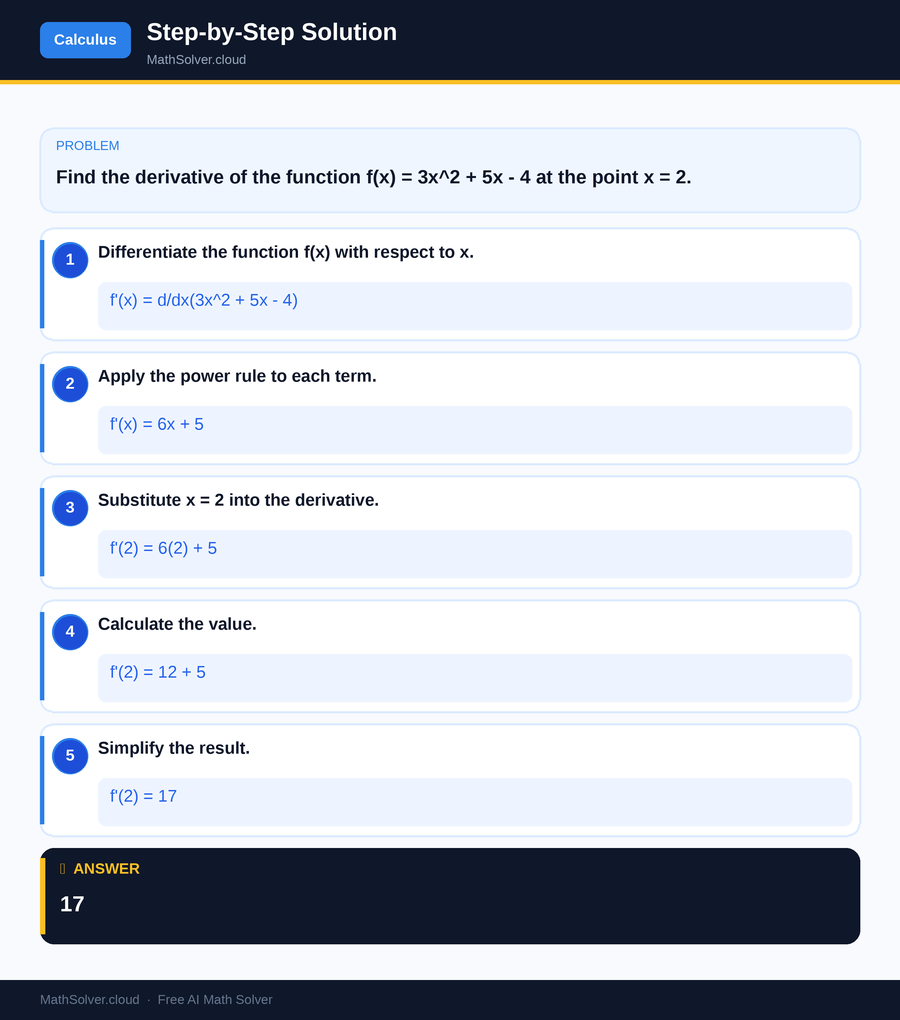
MathSolver Chrome extension solving this problem step-by-step
Example 2
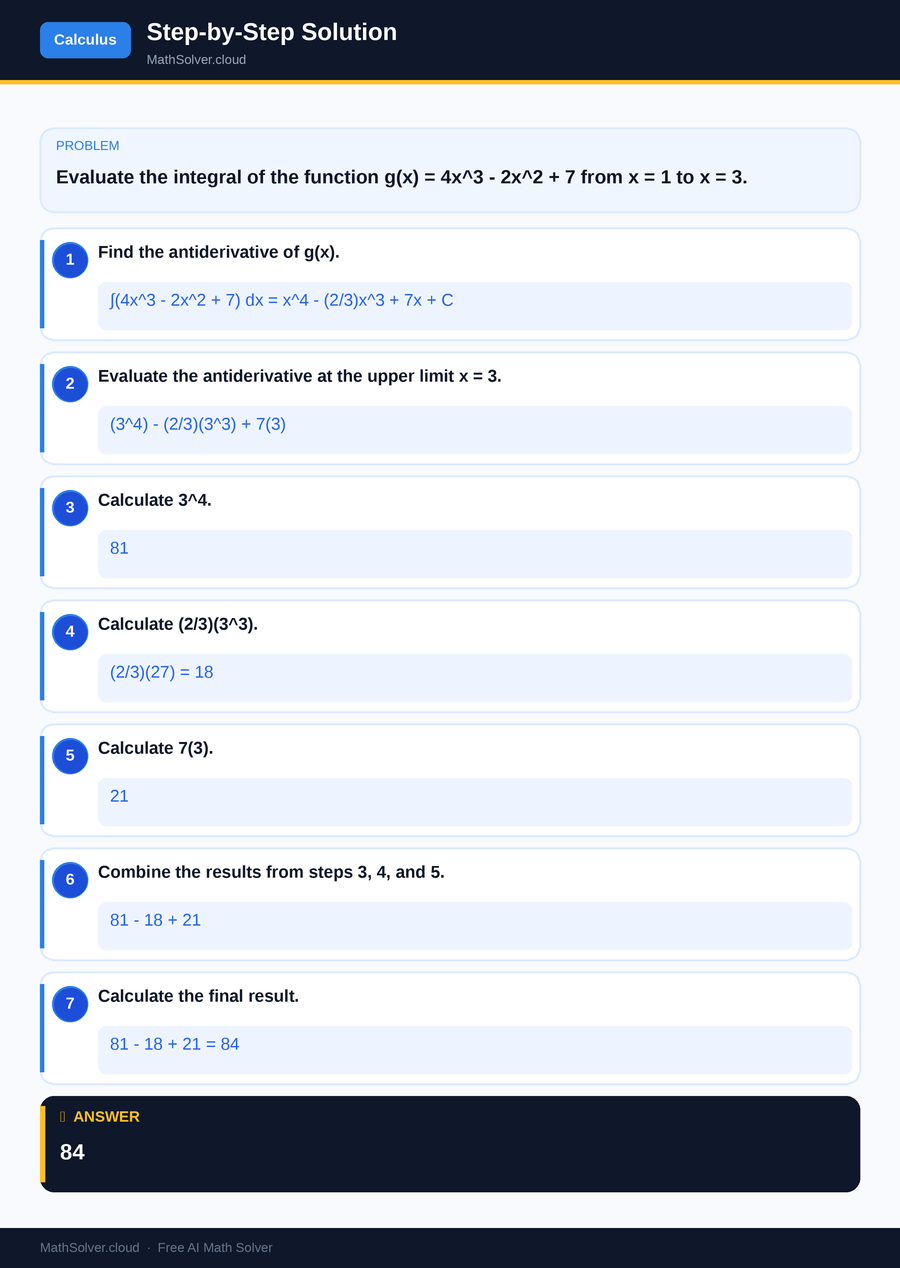
MathSolver Chrome extension solving this problem step-by-step
Common Mistakes to Avoid
One common mistake students make in calculus equations is neglecting to apply the chain rule when necessary. The chain rule is essential when differentiating composite functions, and failing to apply it can result in incorrect answers. Always check if a function is a composition of two or more functions before proceeding with differentiation.
Another frequent error is incorrect algebraic manipulation during integration or differentiation. Small mistakes in simplifying expressions or handling negative signs can lead to significant errors in the final result. To avoid this, double-check your algebraic steps and practice problems regularly to enhance your accuracy.
Real-World Applications
Calculus equations are used extensively in the real world to solve complex problems in various fields. In physics, they are employed to model motion, calculate forces, and analyze energy transformations. Engineers use calculus to optimize designs, evaluate structural integrity, and simulate systems.
In economics, calculus equations help model and predict market trends, optimize resource allocation, and assess economic growth. Understanding these applications can provide valuable insights into how calculus powers decision-making and innovation across industries.
Frequently Asked Questions
❓ What are calculus equations, and why are they important?
❓ How do calculus equations differ from precalculus equations?
❓ How can AI help with calculus equations?
❓ What is the second fundamental theorem of calculus?
❓ How can I improve my calculus skills for the AP Calculus BC exam?
🚀 Solve any math problem instantly
2,000+ students use MathSolver every day — join them for free
📥 Add to Chrome — It's Free