Mastering Calculus with a Calculus Calculator
📋 In this guide
A calculus calculator is an indispensable tool for students tackling the complexities of calculus. Whether you're dealing with derivatives, integrals, or limits, a calculus calculator can simplify the process and help you understand the fundamental concepts more clearly. Many students find calculus challenging due to its abstract concepts and intricate computations. However, with the assistance of a well-designed calculus calculator, these hurdles can become manageable, allowing students to focus on understanding rather than getting bogged down in lengthy calculations.
Calculus calculators are particularly useful because they provide immediate feedback and detailed solutions to various calculus problems. This instant assistance is critical for students who are learning the subject independently or need additional support outside of classroom hours. By incorporating a calculus calculator into their study routine, students can learn to solve complex problems step-by-step, enhancing their comprehension and confidence in the subject.
In this article, we'll explore how to effectively use a calculus calculator, and we'll provide a detailed guide on solving calculus problems. You'll also learn about common mistakes to avoid, real-world applications, and how technology, like the MathSolver Chrome extension, can further aid your learning journey. By the end, you'll have a solid understanding of how to leverage a calculus calculator to its fullest potential.
Step-by-Step: How to Solve Calculus Calculator
Step 1: Understanding the Problem
The first step in using a calculus calculator effectively is to thoroughly understand the problem at hand. Identify whether you're dealing with a problem that requires differentiation or integration. Read the problem statement carefully, and determine what is being asked. For example, if you're asked to find the derivative of a function at a specific point, make sure you recognize the function and the point of evaluation. Clarifying these details will guide you in inputting the correct information into the calculus calculator.
Step 2: Inputting the Function
Once you've understood the problem, the next step is to input the function into the calculus calculator. For a derivative problem, you'll enter the function you need to differentiate. Ensure that the function is entered correctly, paying careful attention to signs, exponents, and coefficients. For integration, specify the function to be integrated and the limits of integration if it's a definite integral. Some calculators also allow you to input expressions in different forms, such as exponential or trigonometric functions, so be sure to select the appropriate form.
Step 3: Choosing the Right Calculator Tool
Calculus calculators come in various forms, from basic derivative calculators to comprehensive AP BC calculus calculators. Depending on your needs, you might choose an integral calculus calculator with steps, which provides detailed solutions for both indefinite and definite integrals, or a pre calculus calculator for foundational concepts. Ensure the calculator you are using is capable of handling the specific calculus operation you need. Some advanced calculators also offer graphical representations, which can be incredibly helpful in visualizing the problem.
Step 4: Interpreting the Results
After processing the input, the calculus calculator will provide you with a solution. It's crucial to interpret these results correctly. For derivatives, verify that the result matches your expectations in terms of sign and magnitude. For integrals, ensure the computed area is reasonable given the function's graph. Some calculators, like the calculus calculator with steps, offer detailed breakdowns of each step, which can be invaluable for learning and understanding the underlying principles. Use these explanations to deepen your understanding and verify the accuracy of the solution.
🤖 Stuck on a math problem?
Take a screenshot and let our AI solve it step-by-step in seconds
⚡ Try MathSolver Free →Worked Examples
Example 1
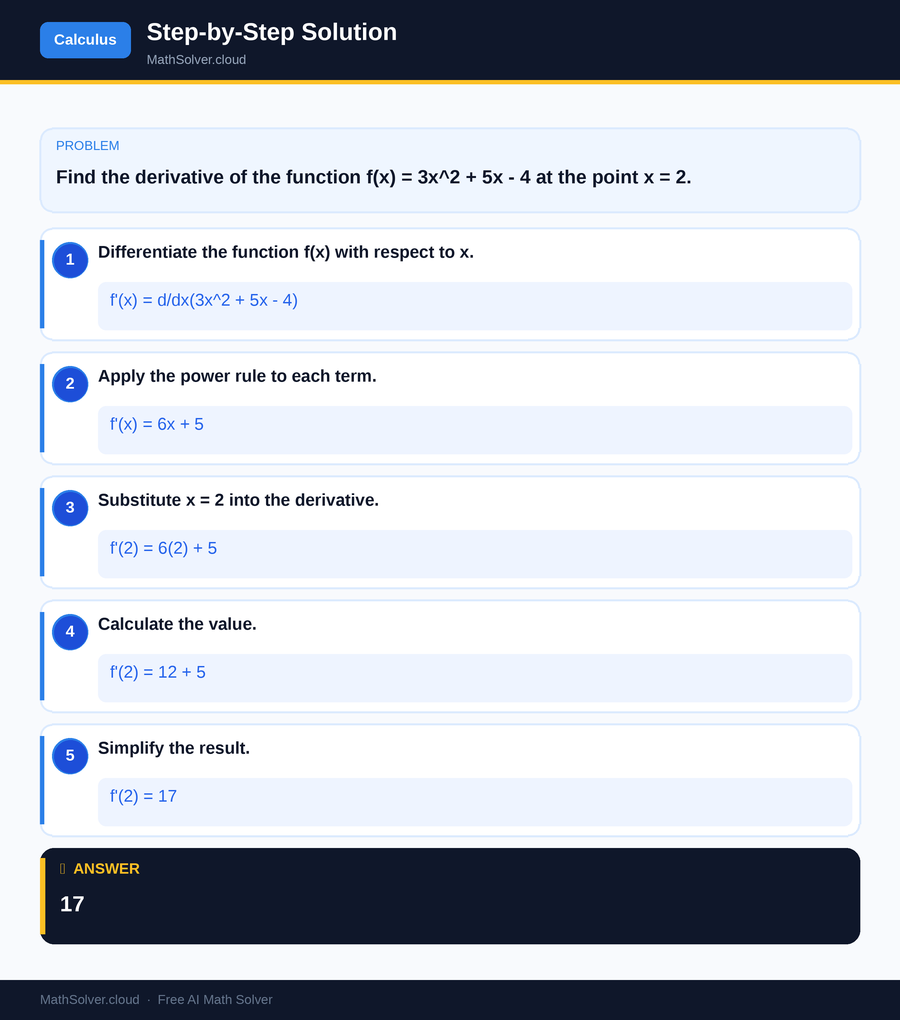
MathSolver Chrome extension solving this problem step-by-step
Example 2
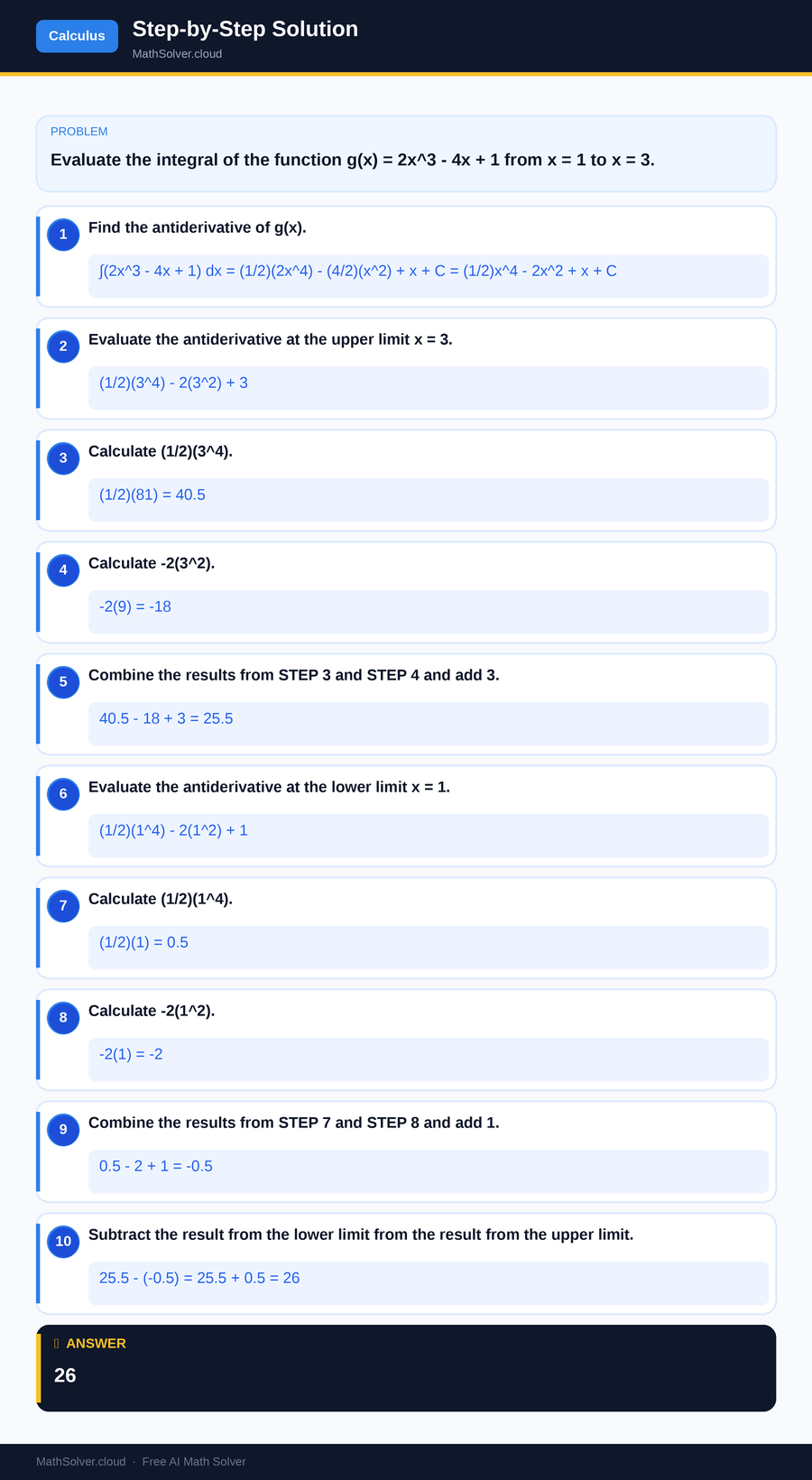
MathSolver Chrome extension solving this problem step-by-step
Common Mistakes to Avoid
One common mistake students make is entering functions incorrectly into the calculus calculator. Misplacing brackets or signs can lead to incorrect results. To avoid this, double-check your input before calculating. Another mistake is misinterpreting the results. Students often accept the output without understanding it, which can hinder learning. Always take the time to analyze the solution and relate it back to the original problem.
Another error involves misunderstanding the scope of the calculator's capabilities. Not all calculus calculators can solve every type of problem, such as differential equations or advanced topics in AP calculus. Ensure that the tool you are using is appropriate for the problem at hand. If you're unsure, refer to resources like our complete Calculus guide to find the right tool for your needs.
Real-World Applications
Calculus calculators are not just academic tools; they have practical applications in various fields. In engineering, they help in designing and analyzing systems by modeling the behavior of circuits, structures, and materials. For instance, calculating the rate of change in electrical circuits or the stress on a beam requires precise calculus computations, which can be efficiently handled by a calculus calculator.
In the realm of economics, calculus is used to model and predict market behavior. Calculus calculators assist in optimizing profit and minimizing costs by analyzing functions related to supply, demand, and consumer behavior. By using these calculators, economists can make informed decisions based on accurate data analysis, contributing to more efficient and effective economic strategies.
Frequently Asked Questions
❓ How does a calculus calculator assist in learning calculus?
❓ Why do students struggle with calculus?
❓ How can AI help with calculus calculators?
❓ What is the difference between a calculus calculator and a pre calculus calculator?
❓ How is the second fundamental theorem of calculus useful?
🚀 Solve any math problem instantly
2,000+ students use MathSolver every day — join them for free
📥 Add to Chrome — It's Free