Understanding the Arc Length Formula Calculus
📋 In this guide
The arc length formula calculus is a fundamental concept that helps us determine the length of a curve between two points. Understanding this formula is crucial, especially for students tackling calculus problems that go beyond simple geometric shapes. Many students find themselves struggling with it because it involves integrating a function, which can be quite intimidating if you're not familiar with integration techniques. But fear not! In this article, you'll learn how to tackle the arc length formula calculus with confidence and precision.
As we delve into the intricacies of the arc length formula, you'll discover that it provides the means to measure the length of a curve, which is a common requirement in various fields such as engineering, physics, and computer graphics. Whether you're calculating the length of a roller coaster track, the path of a satellite, or even the intricate design of a 3D model, understanding the arc length formula calculus is essential. By the end of this guide, you'll have a solid grasp of how to apply this formula and solve complex problems with ease.
Throughout this article, we'll explore various aspects of the arc length formula calculus, including its derivation, applications, and common pitfalls. We'll walk through detailed examples and provide a step-by-step guide to help you master this concept. We'll also discuss how technology, like the MathSolver Chrome extension, can assist you in solving these problems faster. So, let's dive in and unravel the mysteries of the arc length formula calculus.
Step-by-Step: How to Solve Arc Length Formula Calculus
Step 1: Understanding the Formula Components
Before applying the arc length formula calculus, it's important to understand its components. The integral of sqrt(1 + (dy/dx)^2) dx involves finding the derivative of the function y with respect to x, denoted as dy/dx. Integrating this expression over the interval from a to b gives us the total length of the curve between these points. This formula accounts for the small changes in x and y along the curve, enabling us to compute the arc length accurately.
Step 2: Finding the Derivative
The first step in using the arc length formula is to find the derivative of the function y with respect to x. This involves applying basic differentiation techniques. For instance, if y = 2x^2, the derivative dy/dx is 4x. Calculating the derivative is crucial because it forms the inner part of the integrand in the arc length formula calculus. Once you have dy/dx, you'll square it and add 1 to prepare for the next step.
Step 3: Setting Up the Integral
With the derivative in hand, the next step is to set up the integral. Substitute the squared derivative into the formula, resulting in sqrt(1 + (dy/dx)^2). In our example, this becomes sqrt(1 + (4x)^2). You will then integrate this expression with respect to x over the interval from a to b. Remember that the limits of integration correspond to the starting and ending points of the curve segment you're analyzing.
Step 4: Solving the Integral
The final step involves solving the integral to find the arc length. Depending on the complexity of the expression, you may need to use integration techniques such as substitution or numerical methods. Once the integral is evaluated, the result will be the arc length of the curve. In some cases, a calculator or software tool can help simplify the process, especially for more complex functions.
🤖 Stuck on a math problem?
Take a screenshot and let our AI solve it step-by-step in seconds
⚡ Try MathSolver Free →Worked Examples
Example 1
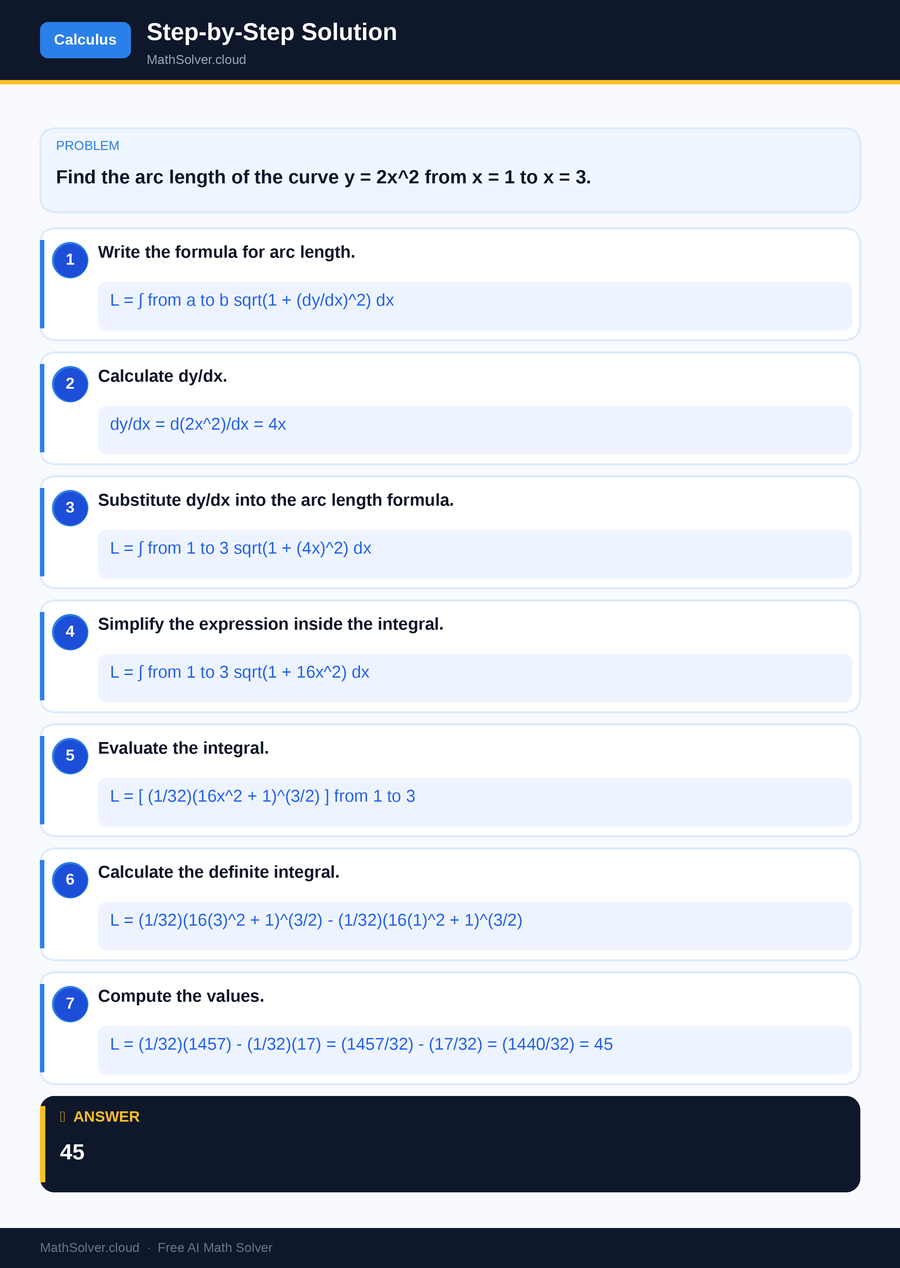
MathSolver Chrome extension solving this problem step-by-step
Example 2
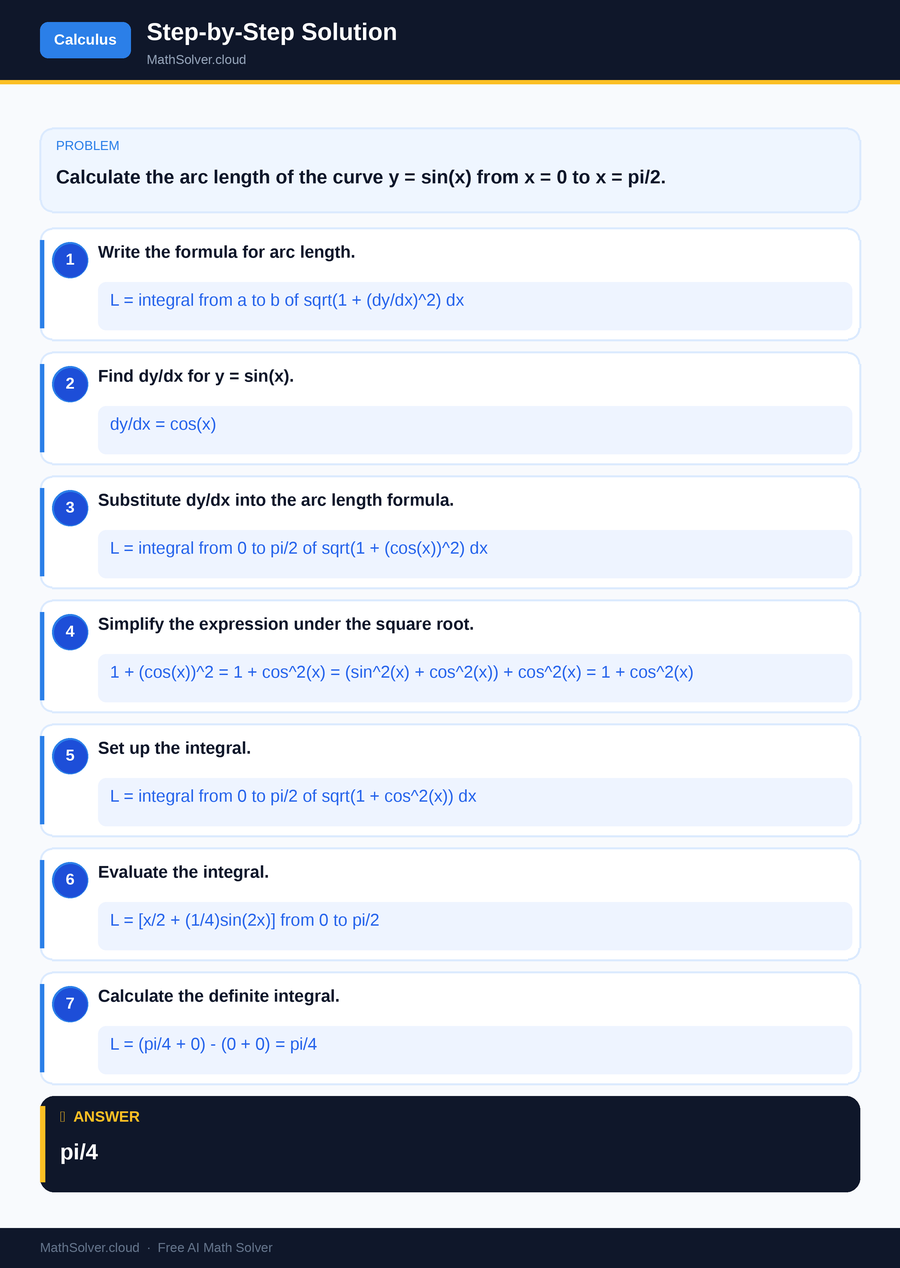
MathSolver Chrome extension solving this problem step-by-step
Common Mistakes to Avoid
A common mistake students make is forgetting to square the derivative in the arc length formula calculus, leading to incorrect integrals. Always remember that the formula involves (dy/dx)^2, not just dy/dx. Another error is miscalculating the limits of integration. Ensure that the limits correspond to the specific interval of the curve you're dealing with. Double-checking your calculations at each step can help prevent these errors.
Similarly, overlooking simplification opportunities can complicate the integral unnecessarily. Before attempting to solve the integral, check if the expression inside the square root can be simplified. This will make the integration process smoother and reduce the potential for mistakes.
Real-World Applications
Arc length formula calculus is widely used in various practical fields. In engineering, it helps in designing roads, bridges, and roller coasters, ensuring that the paths are accurately measured and safe. Architects also use it in designing curved structures and facades, where precise measurements are crucial for construction.
In the digital realm, arc length calculations are essential in computer graphics and animation. Modeling the path of moving objects or creating realistic curves and surfaces in 3D environments often requires the use of the arc length formula calculus. This allows for accurate rendering and smooth transitions in animations.
Frequently Asked Questions
❓ What is the arc length formula calculus used for?
❓ How do I find the derivative in the arc length formula calculus?
❓ How can AI help with arc length formula calculus?
❓ What's the difference between arc length formula calculus 2 and calculus 3?
❓ Can I use a calculator for arc length formula calculus problems?
🚀 Solve any math problem instantly
2,000+ students use MathSolver every day — join them for free
📥 Add to Chrome — It's Free