Mastering the Absolute Value and Step Functions Homework Answer Key
📋 In this guide
Tackling the "absolute value and step functions homework answer key" can be a daunting task for many students, often leading to confusion and frustration. These mathematical concepts form a crucial part of algebra and pre-calculus, and understanding them is essential for solving a wide range of problems. Absolute value represents the distance of a number from zero on the number line, while step functions, often referred to as piecewise functions, involve functions that have distinct constant values over specific intervals. Students frequently struggle with these topics because they require a shift from basic arithmetic to more abstract reasoning.
The absolute value and step functions homework answer key offers a structured approach to mastering these concepts. By using this guide, students can learn to navigate the complexities of these functions, understand their real-world applications, and enhance their problem-solving skills. The key not only provides solutions but also helps students develop a deeper understanding of the underlying principles. This article will break down the concepts, provide step-by-step instructions, and address common mistakes to ensure students gain a comprehensive understanding of absolute value and step functions.
Understanding absolute value and step functions is not just about getting the right answers; it's about developing a mindset for mathematical reasoning. Through this guide, students will learn the essential formulas, explore worked examples, and discover practical applications of these functions in everyday life. By the end of this article, you'll have a solid grasp of these topics and be equipped to tackle even the most challenging problems with confidence.
Step-by-Step: How to Solve Absolute Value And Step Functions Homework Answer Key
Step 1: Understanding Absolute Value
To begin mastering absolute value, you must first understand its fundamental property: it measures the distance of a number from zero on the number line. This means that the absolute value of both -5 and 5 is 5 because they are both five units away from zero. To solve absolute value problems, identify whether the number is positive or negative. If positive, the absolute value is the number itself; if negative, it is the number multiplied by -1. Practice by finding the absolute value of various numbers, including fractions and decimals, to build a strong foundation.
Step 2: Solving Absolute Value Equations
Once you're comfortable with the concept of absolute value, the next step is solving equations that involve it. Absolute value equations often have two separate cases because the absolute value of a number can be positive or negative. For instance, if you have an equation like |x| = 4, this implies that x could be either 4 or -4. To solve equations, set up two equations based on the definition of absolute value and solve each one separately. This method ensures that you consider both possible scenarios for the value of x.
Step 3: Understanding Step Functions
Step functions, also known as piecewise functions, require you to understand how a function can have different values over different intervals. These functions are not continuous and have distinct "steps" or "jumps" at specific values. When dealing with step functions, it's essential to carefully analyze each piece of the function and understand its domain. A common example is the floor function, where f(x) is the greatest integer less than or equal to x. Practice by sketching step functions and identifying the intervals where each piece is defined.
Step 4: Analyzing Step Functions
To fully grasp step functions, practice interpreting and graphing them. Look at each interval separately and determine the constant value of the function in that range. This requires identifying boundary points and understanding how the function behaves at these points. When graphing step functions, remember that they are not smooth curves but consist of horizontal line segments. By working through examples and graphing these functions, you'll develop an intuitive understanding of how they operate.
🤖 Stuck on a math problem?
Take a screenshot and let our AI solve it step-by-step in seconds
⚡ Try MathSolver Free →Worked Examples
Example 1
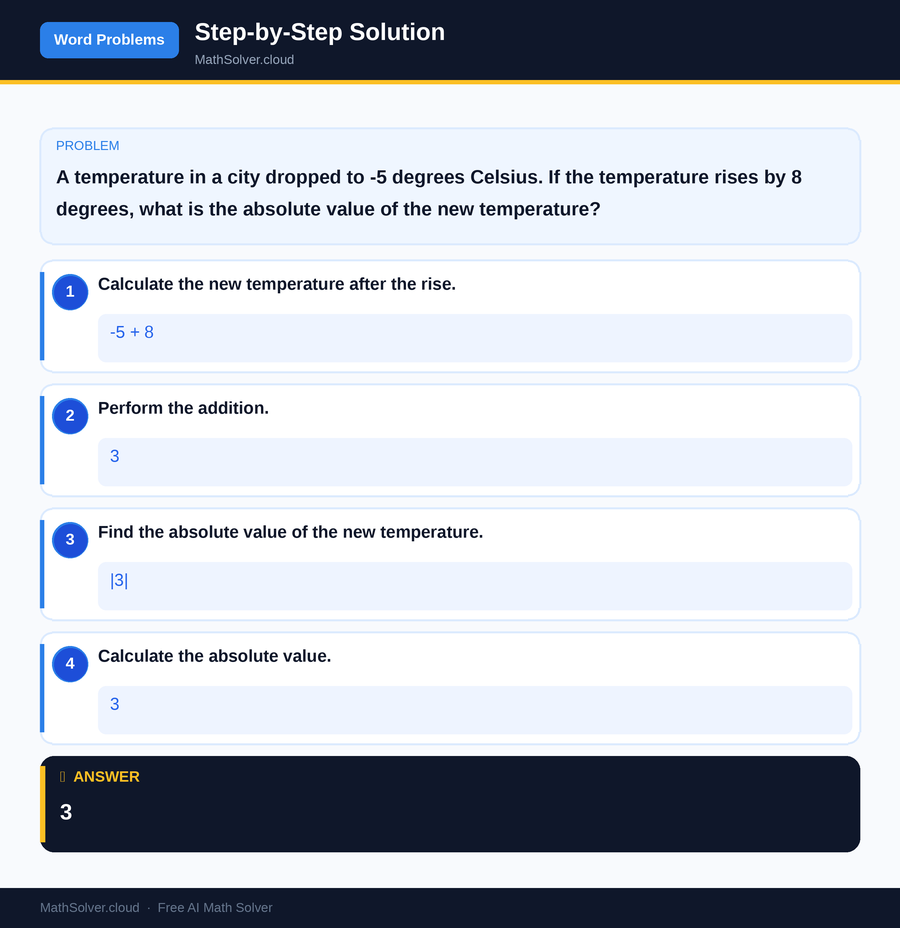
MathSolver Chrome extension solving this problem step-by-step
Example 2
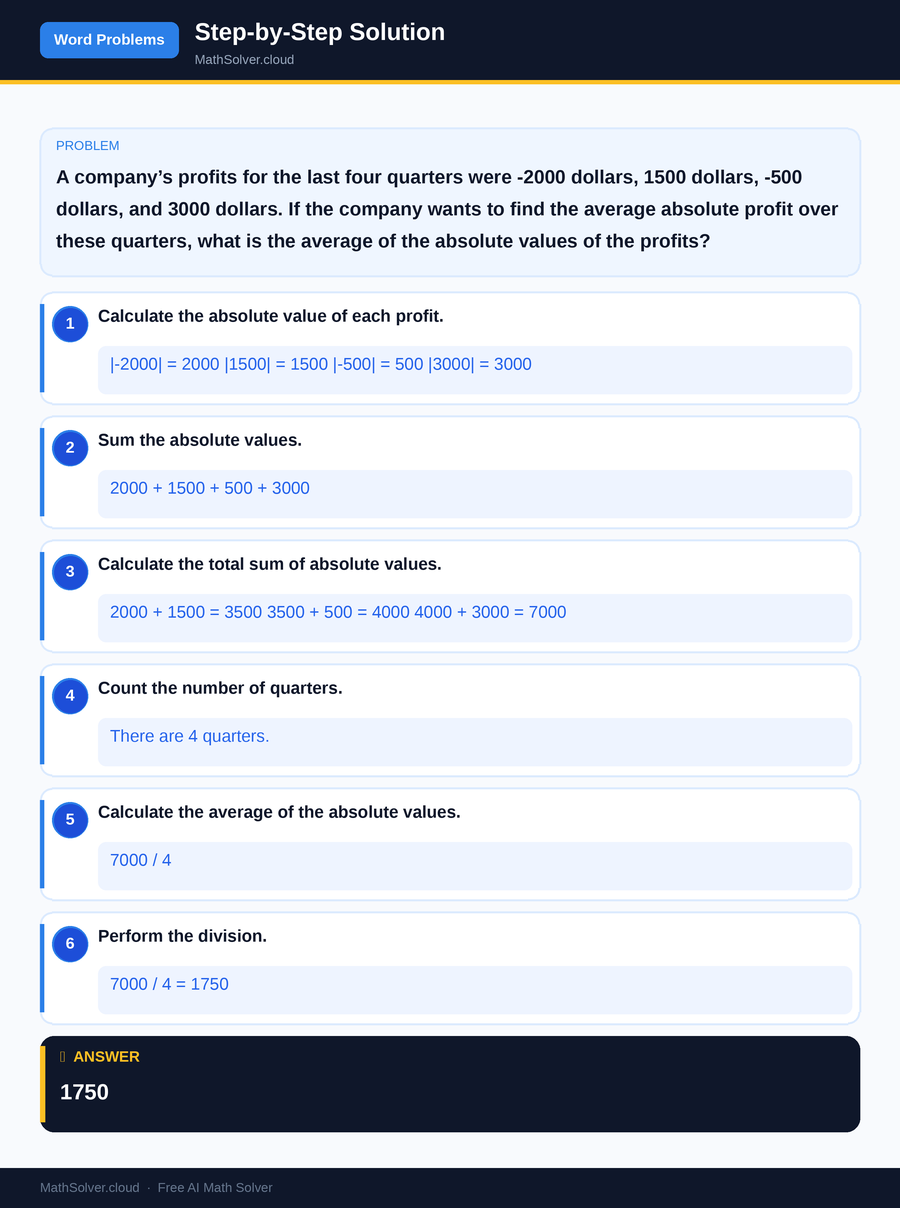
MathSolver Chrome extension solving this problem step-by-step
Common Mistakes to Avoid
One common mistake students make with absolute value is failing to consider both the positive and negative solutions in equations. When solving |x| = a, remember to account for both x = a and x = -a. Another frequent error occurs when students mix up the order of operations, particularly in complex expressions involving step functions. Always follow the correct sequence and pay attention to parentheses and absolute value bars.
In addition, students often misinterpret the domains of step functions by not identifying the correct intervals. This can lead to incorrect graphing or solving of the function. To avoid these mistakes, practice analyzing each piece of the function individually and always double-check your work to ensure accuracy.
Real-World Applications
Absolute value and step functions are not just theoretical constructs; they have practical uses in various fields. Absolute value is frequently used in statistics to measure deviations and in engineering to determine stress and strain on materials. For instance, the absolute deviation is a measure of how much a particular data point differs from the mean, a concept pivotal in quality control processes.
Step functions are widely used in economics and computer science. In economics, they can model situations where quantities change in discrete steps, such as tax brackets or pricing models. In computer science, step functions are utilized in algorithms and digital signal processing, where specific actions are triggered when certain thresholds are met.
Frequently Asked Questions
❓ What is an absolute value and step functions homework answer key?
❓ Why do absolute value equations have two solutions?
❓ How can AI help with an absolute value and step functions homework answer key?
❓ What are some common uses of step functions?
❓ How do step functions differ from continuous functions?
🚀 Solve any math problem instantly
2,000+ students use MathSolver every day — join them for free
📥 Add to Chrome — It's Free